
Housing Disrepair Claims in Rhondda Cynon Taf
Including Trivallis Repairs
Reported the damp months ago and nothing has changed? If Trivallis or another social landlord in RCT has left your home with mould, a leaking roof or no heating, you can force the repairs through and claim compensation for the time you have lived with it.
We act for social housing contract holders across the county borough. See our wider guide to housing disrepair claims in Wales.
Trivallis Repairs Not Being Done
Rhondda Cynon Taf Council transferred its housing stock to Trivallis, which now manages around 10,000 former council homes across Pontypridd, Aberdare, Tonypandy and the valleys. Much of that stock is pre war terraced housing built into steep valley sides, with solid walls, limited cavity insulation and roofs that face driving rain from one direction all winter.
The pattern contract holders describe is consistent. A repair is reported and given a job number, an operative attends and treats the surface, and the job is closed as complete. A few months later the damp returns in the same corner. A closed job is not a completed repair, and where the underlying defect was never addressed the repairing duty was never discharged. The route from there is the same one we use for all housing association contract holders.
Former council homes transferred to Trivallis
Upfront cost to start a claim
Success fee, agreed in writing first
Trivallis Repairs and Complaints, the Facts
What the landlord has published about its own service, and what it means when your repair has stalled.
How to report a repair
[INSERT: reporting routes and Trivallis published emergency, urgent and routine target timescales]
The complaints procedure
[INSERT: stage one and stage two deadlines, then the route to the Public Services Ombudsman for Wales]
Stock and areas covered
[INSERT: confirmed stock figure, transfer date, and the main communities covered]
Damp and mould position
[INSERT: published damp and mould policy and any Ombudsman findings with case reference]. Your underlying protections are set out on our tenant rights page.
Your Rights Under Welsh Housing Law
Housing law in Wales separated from England when the Renting Homes (Wales) Act 2016 came into force in December 2022. If you rent from Trivallis you are a contract holder with an occupation contract, not a tenant with a tenancy, and your landlord owes you two distinct duties. One is to keep the structure, exterior and service installations in repair. The other, under Section 91, is to keep the dwelling fit for human habitation for the whole of the contract. Our guide to landlord repair obligations explains how the two work together.
The fitness duty is where most Welsh claims are won. The Renting Homes (Fitness for Human Habitation) (Wales) Regulations 2022 require the landlord to assess the dwelling against 29 recognised hazards, including damp and mould growth, excess cold, electrical hazards and structural collapse. They also impose three specific requirements that cannot be argued around:
- Working smoke alarms on every storey, mains wired and interlinked
- A carbon monoxide alarm in every room with a gas, oil or solid fuel appliance
- An electrical condition inspection at least every five years, with a copy of the report given to you
If any one of those is missing, the dwelling is unfit regardless of its general condition. That is often the fastest route to establishing the breach, because it does not depend on a surveyor arguing about the cause of damp. Where the dwelling is unfit, rent is not payable for that period, which is a remedy Welsh contract holders have and English tenants do not.
When the Landlord Says the Mould Is Your Fault
This is the single most common response contract holders in the valleys receive. Open the windows. Stop drying washing indoors. Use the heating more. The implication is that the mould is a lifestyle problem rather than a building problem, and once that label is attached the repair file usually goes quiet.
In the stock around RCT it is rarely accurate. Solid wall construction with no cavity, a failed or absent damp proof course, a dead extractor fan, or cold bridging at a gable end will produce exactly the same pattern of mould whatever the household does. A surveyor can distinguish the two in a single visit, and if you have been given this answer it is worth reading what to do when a landlord blames you for the mould before you reply to them.
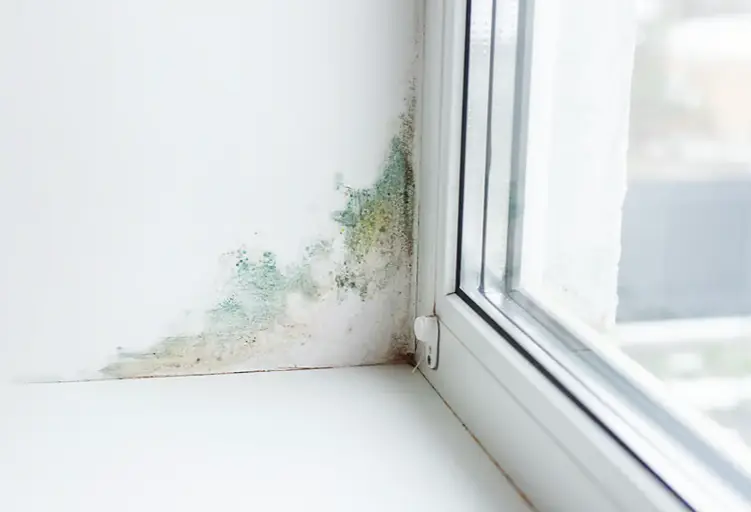
Mould forming at a cold external wall junction, a structural pattern rather than a condensation pattern
Case Examples From RCT Social Housing
Illustrative examples of the case types we handle for Welsh contract holders. Details are composite and do not describe a single identified client. Verified client feedback is on our reviews page.
A family reports mould in two bedrooms repeatedly and is told each time to ventilate better. An independent surveyor instructed on the claim finds a failed extractor and cold bridging at the external wall. The breach of the fitness duty is established, works are scheduled, and damages run from the first report rather than the survey date.
Rain driven against one elevation enters through slipped slates. Three operative visits are logged as completed repairs. The repair history itself becomes the strongest evidence, because it shows notice on three separate occasions and a defect that persisted after each one.
A boiler fails in November and temporary heaters are provided while parts are awaited. Excess cold is a named hazard under the Welsh fitness regulations and temporary heaters do not discharge the duty. The claim covers the period without heating and the additional electricity the household absorbed.
A contract holder asks for the electrical condition report and none exists within the required window. Under the fitness regulations the dwelling is unfit on that ground alone, which settles the breach before any argument about the property's general condition begins.
Why RCT Contract Holders Instruct Us
How the funding works is set out in full on our No Win No Fee page.
We Assess Before We Accept
If the evidence will not carry a claim we say so at the assessment rather than after months of correspondence. An honest no is worth more than a hopeful maybe.
No Win No Fee
Nothing to pay upfront and nothing to pay if the claim does not succeed. The success fee is capped and agreed in writing before anything is signed.
Welsh Law, Not English Law
Occupation contracts, the fitness regulations and the Welsh Ombudsman route all work differently. Firms applying English procedure to Welsh cases lose ground early.
Disrepair We Handle Across the Valleys
Damp and Black Mould
Solid wall stock with no cavity and failed damp proofing produces persistent mould that surface treatment never resolves.
Roof and Penetrating Leaks
Slipped slates, failed flashing and blocked gutters. Valley weather exposes these quickly and patch repairs rarely survive a second winter.
Excess Cold and Broken Boilers
Named explicitly as a hazard in the Welsh fitness regulations. A home that cannot be heated adequately is unfit, whatever the repair log says.
Electrics and Missing Alarms
Exposed wiring, tripping consumer units, or an absent condition report and no interlinked smoke alarms, each of which makes the dwelling unfit on its own.
Rodents and Infestations
Where pests enter through structural defects, sealing the entry point is the landlord's responsibility, not simply treating what is already inside.
Structural Movement
Valley side ground conditions make progressive cracking and movement more common here than on flatter stock, and it needs monitoring evidence over time.
Mould cases are the largest share of what we handle, and the evidence requirements are set out in full on our damp and mould claims page.
How a Trivallis Disrepair Claim Works
Four stages, no cost to you at any point unless the claim succeeds. Our compensation calculator gives a realistic starting range before you call.
Free Assessment
We review your repair history and the condition of the property, then tell you honestly whether the claim is worth running.
Evidence and Survey
We compile your reports, photographs and correspondence, and instruct an independent surveyor to establish the true cause.
Letter of Claim
A formal letter of claim goes to the landlord under the pre action protocol, with a schedule of works and a deadline for disclosure.
Repairs and Settlement
We press for the works to be completed and negotiate damages for the period you lived with the disrepair.
Not a Trivallis Contract Holder
Several social landlords operate in and around Rhondda Cynon Taf. If yours is a different provider, or you are outside the county borough, start from the page that covers you.
We act for council and housing association contract holders in Wales and tenants in England. We do not take private rented sector, leaseholder or shared ownership claims.
The Evidence That Decides a Claim
What to Gather Now
- Every job reference number, with the date you reported it and what the operative actually did.
- Dated photographs taken at intervals. Our guide to photographing damp for a report covers what surveyors actually need.
- All correspondence, including portal messages and text confirmations, which are frequently overlooked.
- GP records where the conditions triggered or worsened a respiratory problem.
What Most People Get Wrong
The strongest evidence is rarely the photograph of the mould. It is the paper trail showing the landlord knew and did nothing. Contract holders who kept a simple dated log of calls and reference numbers settle faster than those with only photographs, because notice has to be proved before condition matters.
If your records are incomplete, that is not fatal. The landlord holds its own repair history and we can require disclosure of it.
Frequently Asked Questions
Can I claim directly against Trivallis
Yes. Where the landlord has failed to keep the dwelling in repair or fit for human habitation, you can bring a claim to compel the works and recover damages. You do not need the landlord's agreement, and the stock transfer from the council does not reduce your rights.
Does Awaab's Law apply to my home in Rhondda Cynon Taf
No. Awaab's Law was introduced under the Social Housing (Regulation) Act 2023 and applies in England. In Wales the equivalent protection comes from the fitness for human habitation duty, under which a dwelling affected by serious damp and mould is unfit from the outset rather than after a missed deadline.
Should I go to the Ombudsman or instruct a solicitor
They do different jobs, and in Wales the complaint route runs to the Public Services Ombudsman for Wales rather than the Housing Ombudsman. The Ombudsman can find maladministration and order a remedy, a claim enforces the repair and recovers damages. Our guide on choosing between the Ombudsman route and a solicitor sets out the trade offs.
Can I be evicted for bringing a claim
If you hold a secure occupation contract with a community landlord, the landlord cannot end it without establishing a ground and obtaining a court order, and bringing a disrepair claim is not a ground. The Renting Homes (Wales) Act 2016 also contains retaliatory eviction protections. We confirm your contract type at the assessment so you know where you stand before anything is issued.
How much compensation could I receive
Damages are usually calculated as a proportion of the rent paid during the period of disrepair, plus belongings damaged and any personal injury element. Be cautious of any firm quoting a figure before seeing your evidence.
Is there a time limit
Generally six years from when the disrepair began for the disrepair itself, and three years for any personal injury element. Where a problem has run longer, the earliest period may fall outside the limitation window.
Starting a Housing Disrepair Claim in Rhondda Cynon Taf
Challenging a landlord that manages ten thousand homes feels one sided, particularly when every previous attempt ended with a closed job and no change at home. The imbalance is smaller than it looks. The landlord has to meet a statutory standard and has to be able to evidence that it did. Where it cannot, the size of the organisation makes no difference. You can read about the team who would handle your case.
Use the Complaints Procedure, but Set a Limit
Logging a formal complaint is worth doing. The written record becomes evidence, and the Ombudsman route generally requires that you have been through it. Where it goes wrong is staying in the internal process indefinitely, accepting each holding response as progress. Give it a defined window, keep every reference number, and treat a second missed deadline as the point to escalate. Our guide to filing a complaint against your landlord covers how to word it so it cannot be closed as a general enquiry.
What Happens When We Take Over
Once instructed, we move the matter out of the customer service queue. A letter of claim under the pre action protocol goes to the landlord's legal team with a schedule of works, a deadline for disclosure of the full repair history, and a request for survey access. Landlords that ignored a year of emails usually respond inside the protocol deadline, because the costs consequences of not doing so are real. That shift is most visible with heating failures in social housing, where the safety risk makes delay very hard to defend.
What You Actually Recover
A successful claim has two halves and the first is usually underestimated. The works are enforced, normally under a schedule with dates attached, so the defect is fixed rather than patched again. Damages then cover the period you lived with it, calculated largely against the rent you paid, plus replacement of belongings ruined by damp or water, plus any injury element. If you want to understand the arithmetic before you call, read how housing disrepair compensation is calculated.
Condensation or Something Structural
Most disputes in valley housing stock come down to this question, because the answer decides who is responsible. Condensation that forms on cold surfaces and clears with ventilation behaves differently from penetrating or rising damp, which leaves tide marks, salt deposits and damage that returns in the same place regardless of how the home is used. The difference between condensation and structural damp is worth understanding before your next conversation with the landlord.
If your repair has been outstanding for months and the last thing you received was an apology rather than a date, that is the point to get it assessed. Contact our team and we will tell you within 24 hours whether the claim is worth running.
Start Your Claim Today
Free assessment. No obligation. Welsh housing law specialists.
Start Free Assessment → 📞 Call 07460 754041Submit Your Enquiry
Use the quick form to send your details directly.
Claim Pages
Ready to Get the Repairs Done
Free assessment, no obligation, and an honest answer about whether your claim is worth running.
What Could Your Claim Be Worth
Damages depend on how long the disrepair has run, the rent paid during it, the belongings damaged and the effect on your health. We give you a realistic range once we have seen the evidence, not before.
Use the compensation calculator