
If you have no heating council flat what to do is simple at first: report the fault to your council or housing association immediately, get a repair reference number and say clearly whether you also have no hot water, vulnerable people live in the home or the temperature is affecting your health. Your landlord must keep heating and hot water installations in repair and proper working order, but the exact repair deadline depends on the problem and its urgency. If the repair is delayed, you may be able to pursue no heating or hot water compensation.
No heating can turn from inconvenient to unsafe surprisingly quickly. That is especially true for babies, older residents, disabled people and anyone with a health condition made worse by cold. Do not wait to see whether the boiler starts again tomorrow.
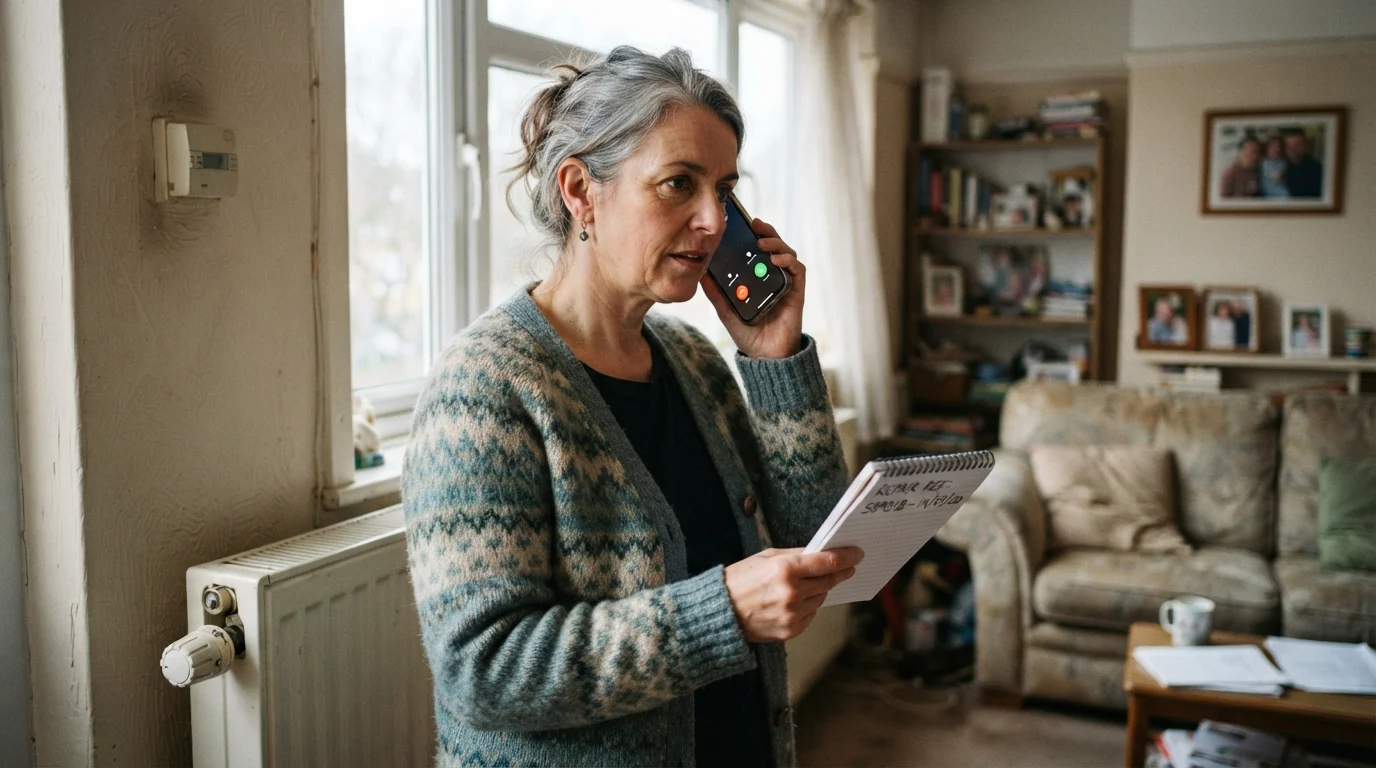
Start with an urgent repair report
Use your landlord’s emergency repairs line if the heating has stopped completely, particularly between late autumn and spring. If there is no heat and no hot water, say both. Councils can prioritise a total loss of heating differently from a radiator that is only partly warming up.
When you make the report, ask for:
- The repair reference number
- The repair category, such as emergency, urgent or routine
- The target attendance or completion date
- Whether temporary heaters will be provided
- What to do if the contractor does not arrive
Write down the time of every call, the name of the person you spoke to and what they promised. A screenshot of an online report is useful too. It sounds basic, but it matters later if the council says it was never told about the problem.
Your council landlord is normally responsible for the boiler, fixed heating system, pipes, radiators and hot water system. Section 11 of the Landlord and Tenant Act 1985 requires landlords to keep installations for heating and hot water in repair and proper working order.

How quickly should it be fixed?
There is no single legal rule saying every heating repair must be fully completed within a set number of hours. The legal test is generally a reasonable time after the landlord has been told. What counts as reasonable depends on the risk, the weather, the availability of hot water, the condition of the household and the work needed.
For council tenants in England, the Right to Repair scheme can apply to certain qualifying urgent repairs costing less than £250. Under the standard scheme, a total or partial loss of heating or hot water is usually treated more urgently in colder months.
| Situation | Usual response expectation in England | What to ask for |
|---|---|---|
| No heating or hot water between 31 October and 1 May | Within 1 working day under the standard Right to Repair timescale, where the repair qualifies | Emergency repair reference and temporary heating |
| No heating or hot water between 1 May and 31 October | Within 3 working days under the standard scheme, where the repair qualifies | Urgent repair timescale and confirmation of next steps |
| Gas smell or suspected carbon monoxide | Immediate emergency action | Leave the property, call 0800 111 999 from outside and report it to the landlord |
| Communal heating failure | Varies by landlord policy and scale of outage | Written updates, temporary heating and expected restoration time |
The table is a guide, not a reason for a landlord to delay where someone is at risk. Your tenancy agreement and the council’s published repairs policy may promise a faster response. Read those documents carefully.
What often gets missed is the word “qualifying”. A Right to Repair deadline is not a blanket guarantee that every heating issue will be permanently fixed within one day. The contractor may need to make the property safe, provide heaters, diagnose the fault or obtain parts. Still, a landlord should explain what is happening rather than leave you in the cold with a vague promise to “chase it”.
If the contractor does not attend
First, call the repairs service again. Quote the original reference number and ask whether the job has been reassigned to another contractor. If you are using the Right to Repair scheme and the first contractor misses the deadline, tell the council. It should arrange for a second listed contractor to complete the qualifying repair.
If the second contractor also misses the relevant deadline, compensation can become payable under the scheme. The standard amount is £10, followed by £2 for each further working day, up to £50. The payment is modest, frankly, but the formal process can create a clear record that the repair was not handled properly.
Keep records of:
- Repair references and appointment messages
- Photos of thermostat readings or boiler error codes
- Temperatures inside the flat, with dates and times
- Receipts for reasonable extra electricity used for temporary heating
- Medical advice where cold conditions have affected health
- Emails asking for a clear plan and updates
Do not attempt boiler or gas repairs yourself. Never use an oven, hob or barbecue to heat the flat. They create serious fire and carbon monoxide risks.
Ask for temporary help
A council may provide portable heaters while a repair is outstanding, especially where the household includes a child, someone aged over 65, a pregnant person or a resident with a relevant health condition. Ask directly. Do not assume the contractor will offer.
For a longer outage, ask whether the landlord will consider:
- Additional temporary heaters
- A safe way to heat one room rather than several costly rooms
- Electricity cost support or reimbursement
- Temporary accommodation where the flat cannot be kept safe
- Extra welfare checks for a vulnerable resident
Communal systems can be harder to resolve because one plant room, pipework fault or supply issue may affect dozens of flats. That does not remove the landlord’s responsibility. It means the council should communicate better, give realistic restoration information and consider how residents will stay warm in the meantime.
Housing Repair Solutions can help tenants understand their options where heating failures, missed appointments and poor repair handling continue.
Make a formal complaint
A repair request is not automatically a complaint. If missed appointments, poor communication or repeated temporary fixes are part of the problem, submit a formal complaint through the landlord’s complaints process. Explain the dates, the impact on your household and what outcome you want.
Keep the wording factual. For example:
“I reported a total loss of heating and hot water on 4 January. The contractor did not attend on the appointment date and I have received no revised completion date. My household includes a resident with asthma. Please treat this as a stage one complaint, confirm the repair plan and provide safe temporary heating.”
Social landlords must operate a two stage complaint process. The Housing Ombudsman says landlords should acknowledge a stage one complaint within five working days and provide a written response within 10 working days of acknowledging it. A stage two response should normally follow within 20 working days of acknowledgement.
If the council’s final response does not resolve the issue, you can take the case to the Housing Ombudsman. This service can investigate councils and housing associations, including poor repair handling, poor communication and failures to follow complaint procedures. You generally have 12 months from the landlord’s stage two response to refer the complaint.
Do not stop paying rent
It can feel tempting to withhold rent until the heating is fixed. Don’t do it without specialist advice. Rent arrears can put your tenancy at risk, even where the council has handled the repair badly.
Instead, keep paying your rent and ask for a rent reduction, reimbursement of reasonable costs or compensation through the landlord’s complaint process. Shelter specifically warns that withholding rent for repairs can lead to eviction action.
If the problem creates a serious health or safety hazard and your landlord is not acting, contact your local council’s environmental health or private sector housing team. This is more relevant where the landlord is a housing association rather than the council itself, although councils still have legal duties to address serious hazards under the Housing Health and Safety Rating System.
When a heating specialist can help
A council tenant should always report the fault to their landlord first. If the landlord has authorised an inspection, needs a written diagnosis or is arranging approved works, [Service/Business Name] can help with clear heating fault diagnosis and repair information for homes across [Service Area]. The key is to get written authorisation before arranging any chargeable private work, because the council may not reimburse an unapproved repair.
For related support, consider adding internal links to your pages on emergency boiler repair costs, heating system fault diagnosis and what to do when a landlord will not arrange repairs.
No heating in a council flat should not become a battle of repeated phone calls. Report it promptly, record every contact, ask for the specific support your household needs and move to a formal complaint when repair handling falls short. The paper trail may not warm the flat, but it gives you far more leverage to get the problem resolved.
Frequently asked questions
How long can a council leave you with no heating?
A council should repair the issue within a reasonable time, but the urgency depends on the season, whether hot water is also unavailable and who lives in the home. In England, qualifying heating or hot water repairs under the Right to Repair scheme are generally due within one working day in colder months.
Is no heating in a council flat an emergency?
No heating can be an emergency, particularly in cold weather or where a child, older person, disabled resident or someone with a health condition lives in the property. Tell the repairs service about these circumstances when reporting the fault, because they can affect how the repair is prioritised.
Can I claim compensation for no heating in council housing?
You may be able to claim compensation if a qualifying Right to Repair job is not completed on time, or through the council’s formal complaints process where poor service caused loss or distress. Keep repair references, appointment records, photos and receipts to support your request.
What if my council keeps cancelling heating appointments?
Ask the council to confirm the new appointment in writing and make a formal complaint if cancellations continue. State the original report date, every missed appointment and the impact on your household. If the final complaint response is unsatisfactory, you can refer the matter to the Housing Ombudsman.
Can I withhold rent because the council has not fixed my boiler?
No, not without getting specialist housing advice first. Withholding rent can create arrears and jeopardise your tenancy. Continue paying rent, document the issue and seek a rent reduction, compensation or reimbursement through the council’s complaint process instead.
Who do I contact if there is a gas smell or possible carbon monoxide leak?
Leave the property immediately and call the National Gas Emergency Service on 0800 111 999 from outside. Then report the emergency to your council landlord. Do not turn electrical switches on or off, smoke, use flames or try to repair the appliance yourself.