

If your landlord or council is blaming you for mould, you have strong rights to push back. Under UK law, landlords must investigate damp and mould properly and fix structural causes. They cannot simply claim it is condensation without evidence, and you can escalate to environmental health or take legal action if they refuse to act.
Why landlords blame tenants (and why it often does not hold up)
It is frustrating, but predictable. A landlord says the mould is your fault because it is cheaper and quicker than fixing a leak, replacing failed pointing, or upgrading ventilation. They will say you are not heating enough, not opening windows, or drying clothes indoors. Sometimes that is partly true. Often it is not the main cause.
What often gets missed is that UK housing law has moved decisively against this deflection. The Housing Ombudsman ruled in 2021 that lifestyle alone is not a valid defence for social landlords. Since October 2025, Awaab’s Law imposes fixed deadlines on social landlords to investigate and fix significant damp and mould. The Renters’ Rights Act 2025 extends similar duties to the private rented sector from May 2026, with councils able to fine landlords up to £7,000 for serious hazards from June 2026.
So why does this keep happening? Because enforcement still depends on tenants pushing back with the right evidence and using the right escalation routes.
Who is actually responsible for mould under UK law
The short version: it depends on the cause, but the burden to find that cause sits with the landlord once you have reported the problem.
Landlord responsibilities typically include:
-
Structural defects such as leaking roofs, cracked render, failed damp-proof courses, rotten window frames, and faulty gutters.
-
Penetrating damp and rising damp, which by definition come from the building, not daily living.
-
Inadequate or broken ventilation systems, including extractor fans that do not work or air bricks that are blocked.
-
Investigating reported damp and mould within set timescales under Awaab’s Law (social housing) and the Decent Homes Standard (private rentals from 2026).
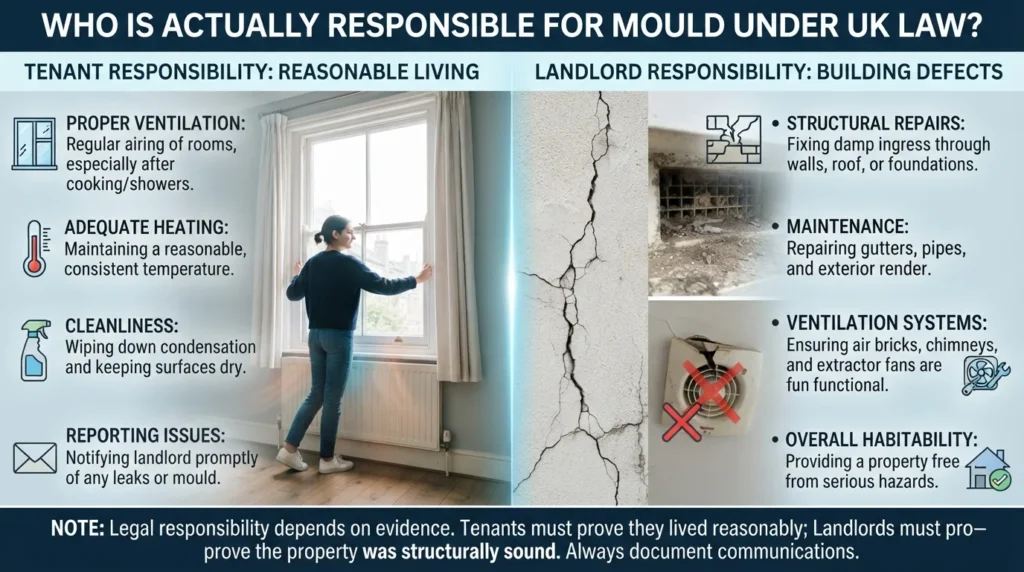
Tenant responsibilities are narrower:
-
Using the property in a tenant-like manner, which means reasonable heating, ventilation where physically possible, and reporting issues promptly.
-
Not causing damage deliberately or through clear negligence, such as never ventilating a bathroom with a working extractor fan.
Crucially, your landlord is usually only responsible from the moment they know about the problem. That is why written notification with dates and photos matters so much.
How to prove the mould is not your fault
This is where many tenants lose ground. They argue in general terms. The landlord says condensation. Nothing changes. You need specific, hard evidence that points to a structural or systems failure.
Step-by-step evidence checklist:
-
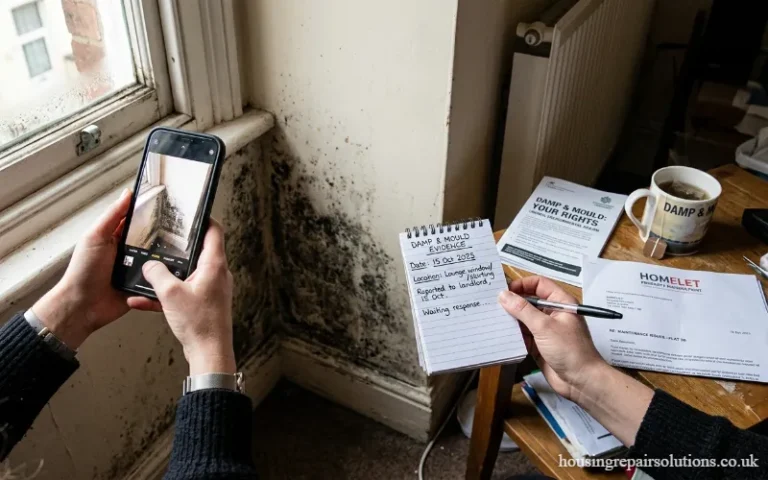
Photograph everything with dates visible. Use your phone’s date stamp or a platform that creates tamper-evident timestamps. Capture the mould, any water staining, peeling paint, and the wider wall or ceiling area.
-
Record the pattern. Mould in top corners of external walls, behind wardrobes on outside walls, and around window reveals often indicates condensation. Mould below bathrooms, along skirting boards on external walls, or spreading from window frames can signal penetrating damp or leaks.
-
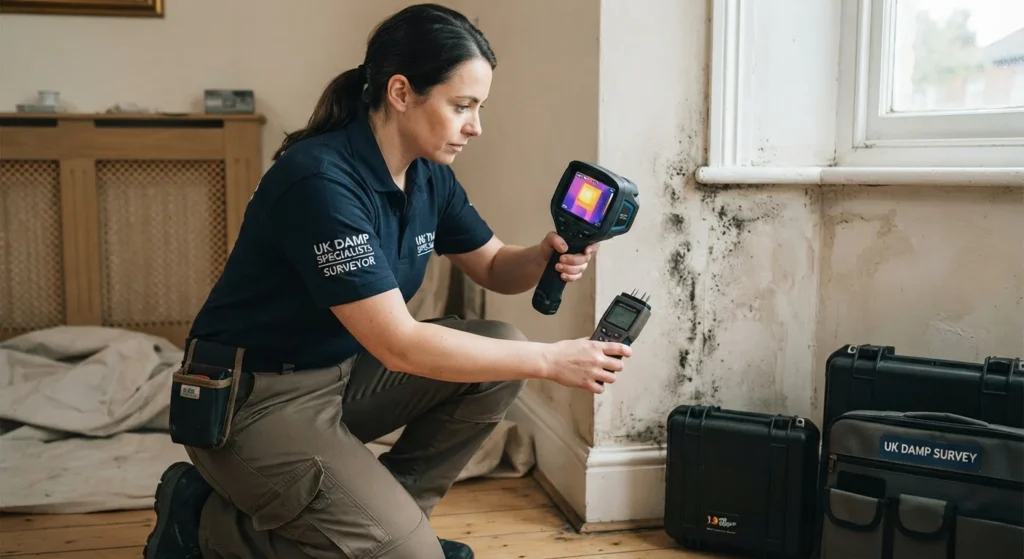
Use a basic moisture meter. These cost around £15 to £30 online. Take readings on the affected wall and compare them to an internal partition wall. Elevated moisture deep in the structure, not just on the surface, points away from simple condensation.
-
Document your behaviour. Keep a simple log for two to three weeks showing when you heat, ventilate, and whether you dry clothes indoors. Note if windows cannot open fully, if extractor fans are missing or broken, or if air bricks are blocked.
-
Check the history. If previous tenants reported the same issue, that strongly suggests a structural cause. You can sometimes uncover this via Freedom of Information requests to the local authority for past complaints or enforcement on the address.
-
Consider an independent damp survey. A qualified surveyor can distinguish between condensation, penetrating damp, and rising damp using moisture mapping and thermal imaging. This typically costs between £200 and £500 but can be decisive if your case goes to court or a housing disrepair claim.
In practice, the most common mistake is waiting too long to gather this evidence. By the time you escalate, the landlord has already cemented their condensation narrative.
What to do when the council or landlord blames you
You have three main escalation routes, and you can use more than one at the same time.
1. Formal complaint to your landlord
Write to your landlord or letting agent by email or letter. Set out exactly where the mould is, when you first noticed it, what you have done to mitigate it, and that you need them to investigate the cause. Ask for a written response within 14 days. Keep copies of everything.
For social housing tenants, reference Awaab’s Law deadlines: 24 hours for emergency hazards, 10 working days to investigate significant damp and mould, and five working days to make safe after investigation.
2. Request an environmental health inspection
If your landlord does not act or keeps blaming you, contact your local council’s environmental health or private renting team. Explain that the property may be unfit for human habitation due to damp and mould. They can inspect, issue improvement notices, and in severe cases fine or prosecute the landlord.
This route is especially powerful when you have moisture readings, photos showing structural damp patterns, or evidence of previous complaints at the address.
3. Legal action for housing disrepair
Under the Homes (Fitness for Human Habitation) Act 2018 and Section 11 of the Landlord and Tenant Act 1985, you can bring a disrepair claim if your landlord fails to fix hazards that affect health or safety. The court can order repairs and award compensation. Many housing disrepair solicitors work on a no win, no fee basis for serious cases.
You do not have to move out to pursue this, but you should keep paying rent while you wait for repairs unless you have specific legal advice telling you otherwise.
A quick decision guide: is this likely your responsibility or the landlord’s
This table is not a diagnosis. It is a way to focus your evidence gathering before you escalate.
When to get specialist help
If your landlord or council is still blaming you after you have provided clear evidence, it is time to bring in external pressure. An independent damp survey can shift the balance quickly. So can a letter from a housing disrepair solicitor.
For tenants in England, our team at [Service/Business Name] regularly supports clients in documenting mould issues, liaising with environmental health officers, and preparing strong disrepair claims where landlords refuse to accept responsibility. We work across [your service area, e.g. London and the South East] and can help you understand whether your case is strong enough for legal action.
FAQ
My landlord says the mould is condensation because I do not heat enough. Is that legal?
Not on its own. Landlords must investigate the actual cause of damp and mould, not assume it is lifestyle. If the property cannot maintain reasonable temperatures with normal heating, or if ventilation is inadequate, that is often a structural issue.
Can the council force my landlord to fix mould if they keep blaming me?
Yes. Environmental health officers can inspect and, if they find hazards, issue improvement notices requiring repairs. Councils can fine landlords up to £7,000 for serious category 1 hazards from June 2026.
Do I have to pay for an independent damp survey?
You can choose to pay privately, typically £200 to £500. In successful housing disrepair claims, survey costs and legal fees are often recoverable from the landlord. Some solicitors will arrange surveys as part of a no win, no fee case.
What if I am a social housing tenant and my council is the landlord?
Awaab’s Law applies directly to you from October 2025. Your council must investigate significant damp and mould within 10 working days and make the home safe within five working days after investigation. You can still complain internally, then go to the Housing Ombudsman if they fail to comply.
Can I withhold rent if my landlord will not fix mould?
Generally no. Withholding rent without proper legal steps can put you at risk of eviction for arrears. The safer route is to keep paying rent while you pursue repairs through environmental health or a disrepair claim. Get specific legal advice before taking any action on rent.
How long do I have to make a housing disrepair claim for mould?
You usually have up to six years from when the disrepair occurred in England, but it is best to act as soon as possible. Delays can affect both your health and the strength of your evidence.
Final thoughts
Being blamed for mould is exhausting, especially when you know you are doing your best to heat and ventilate. The law now gives you clearer tools to push back, but those tools only work if you use them with solid evidence and a structured approach.
Start by documenting the problem properly, then move quickly through formal complaint, environmental health, and, if needed, legal action. You do not have to accept a lazy condensation narrative when the building itself is the real culprit.