
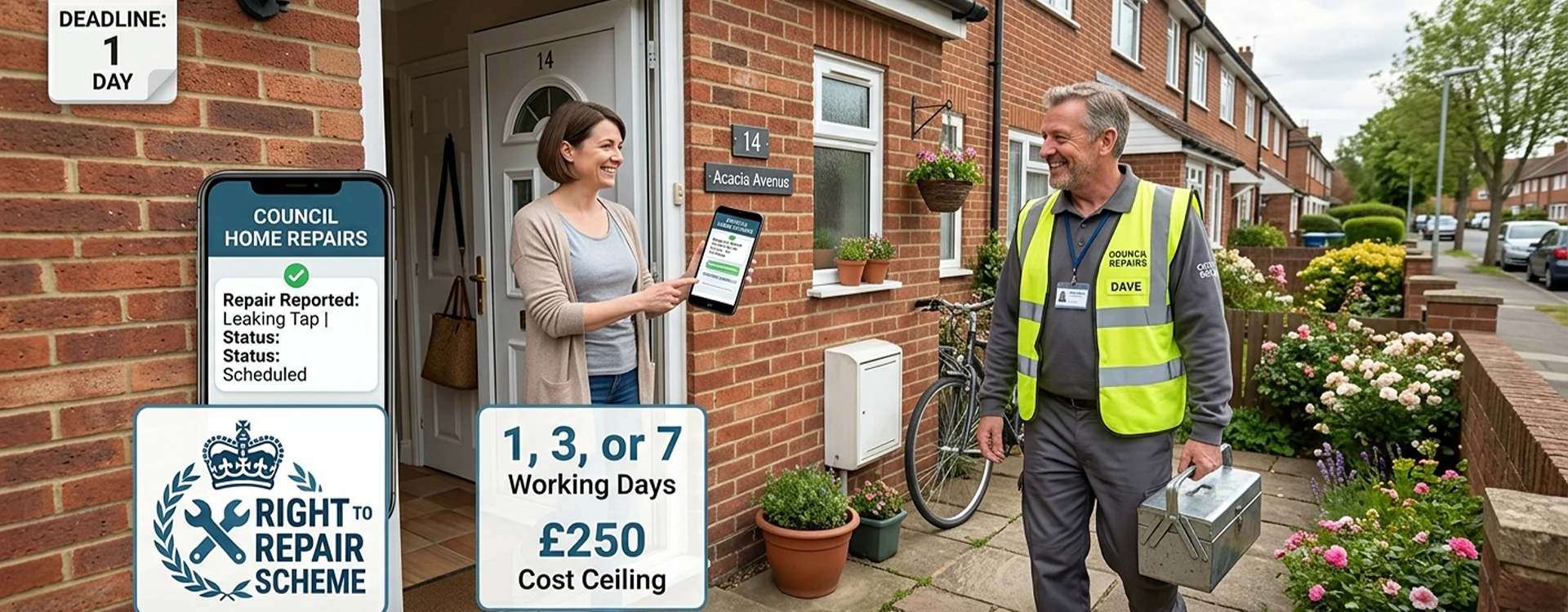
In England, the right to repair scheme that council tenants can use requires certain small, urgent repairs to be completed within one, three, or seven working days. The repair must qualify and cost no more than £250. Compensation normally follows only if the replacement-contractor deadline is also missed. General information, not individual legal advice; for help with your own situation, you can contact Housing Repair Solutions. This guide explains England’s scheme; rules elsewhere in the UK differ.
Who can use the scheme?
English council tenants with secure, flexible, or introductory tenancies can use the scheme. Housing associations in England don’t have to operate this statutory council scheme, although some offer similar arrangements. The repair must be the council’s responsibility, appear on the qualifying list, and have an estimated cost no higher than £250. The regulations exclude landlords with fewer than 100 homes let to secure tenants. If your repair falls outside these limits, or your landlord keeps delaying essential work, housing disrepair claims may be another route to get the problem fixed. Don’t apply England’s figures across the UK. Scotland’s separate scheme includes Scottish secure and short-term tenants of councils and housing associations, with a £350 repair ceiling. Northern Ireland has separate arrangements, while Wales uses Renting Homes legislation for repair duties.
Right to repair scheme council deadlines: what qualifies?
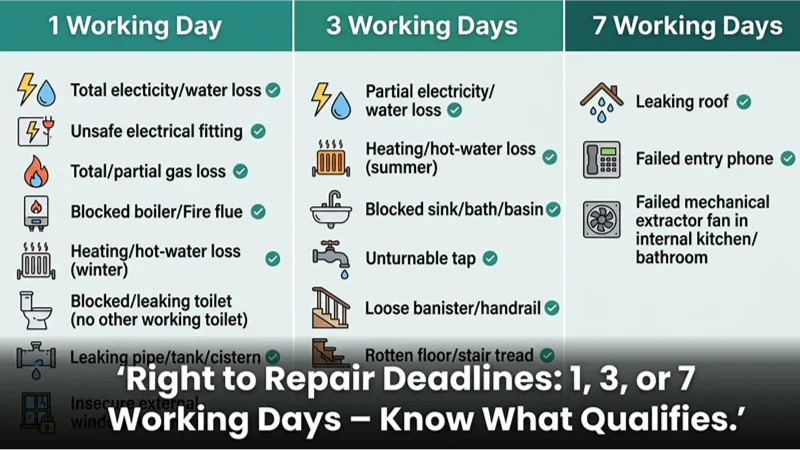
These are completion periods, not simply targets for answering your call. The following groups cover the statutory repair list; all remain subject to eligibility and the cost ceiling.
| Repair or defect | Working days | Important condition | What to explain when reporting |
|---|---|---|---|
| Total electricity or water loss; unsafe electrical fitting | 1 | Partial supply loss differs | Whether the whole home is affected |
| Partial electricity or water loss | 3 | Not total loss | Which supplies still work? |
| Total or partial gas loss; blocked boiler or fire flue | 1 | Listed qualifying defects | Precisely what has stopped working |
| Heating or hot-water loss | 1 winter; 3 summer | Seasonal dates determine the period. | Whether heating, hot water, or both have failed |
| Blocked/leaking foul drain or soil stack; blocked/leaking toilet; toilet not flushing | 1 | Toilet defects require no other working toilet. | Whether another toilet works |
| Leaking water/heating pipe, tank, or cistern | 1 | Different from a roof leak | Where the leak originates |
| Insecure external window, door, or lock | 1 | Security defect | Whether it can be secured |
| Blocked sink, bath, or basin; unturnable tap | 3 | Listed plumbing defects | Which fitting is affected? |
| Loose banister/handrail; rotten floor or stair tread | 3 | Listed safety defects | Location and condition |
| Leaking roof; failed entry phone; failed mechanical extractor in internal kitchen/bathroom | 7 | Fan location matters | The affected room or entrance |
Source: the 1994 Right to Repair Regulations, including their schedule. The heating entries use seasonal boundary wording, so request written confirmation of the applicable deadline around May and October.
How to get a qualifying repair completed: 3-step implementation plan
1. Report the defect and request the repair notice
Use your council’s reporting service and take a reference number. Explain the real flaw as opposed to just marking everything “urgent.” Ask if it qualifies, which contractor is on it, and what date applies. The council must give you a copy of the notice or tell you why the repair doesn’t count.
2. Review the time and safeguard access.
Exclude weekends and public holidays. Generally, the period starts on the first working day after a report and covers normal working days; similarly, different rules apply for non-working-day reports and cases that require inspection. Schedule visits and instructions to access. Instead of calculating from the first call-in, ask for the stated deadline.
3. After missing the initial deadline, request another contractor.
Tell the council clearly that you require another contractor under the scheme if the repair is unfinished. Put it in writing. The council must serve a further repair notice with a further deadline if reasonably practical. A routine chase-up won’t necessarily record the request to replace the contractor or result in compensation.
How compensation works
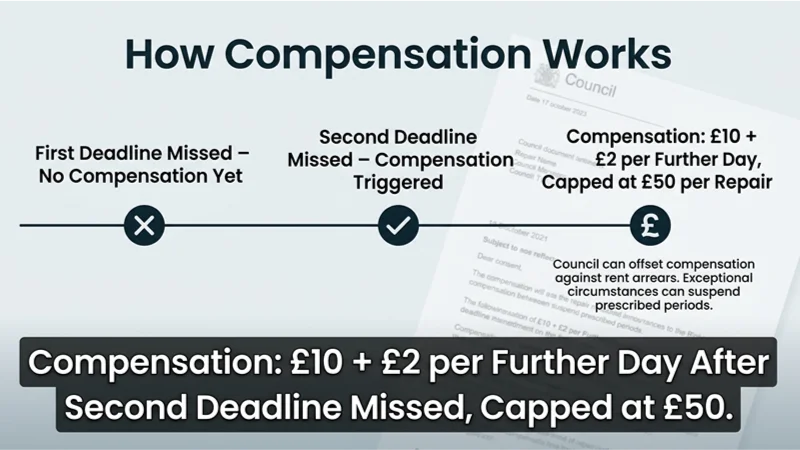
Missing the first deadline does not, by itself, trigger the scheme’s compensation payment. If the qualifying repair remains unfinished after the second prescribed period, compensation is £10 plus £2 for each further day, capped at £50 per repair.
The council can offset compensation against money you owe it, including rent arrears. Exceptional circumstances beyond the council’s or contractor’s control can suspend the prescribed periods; ask what circumstances it relies on and which dates are affected.
Practical checks before chasing
Keep the original repair reference alongside the replacement-contractor request.
Ask for completion dates, not just appointment dates.
Save messages showing you offered access.
If refused, request the reason: cost, responsibility or repair category. These details help identify what needs challenging.
Frequently asked questions
Who qualifies for the Right to Repair scheme?
In England, it is available to secure flexible introductory council tenants. Eligibility also depends on the repair, estimated cost, and landlord. Tenants of housing associations should ascertain their landlord’s policy rather than assume that the English council scheme automatically applies. Scotland has a distinct, inclusive social landlord scheme.
Which repairs do councils have to do in one day?
Examples include overall water or electricity loss, unsafe fittings and installations, insecure external doors and windows, and some leaks. Any faulty toilet with no other working toilet qualifies on this timescale. One day only applies when the other conditions of the scheme are satisfied.
When does the repair deadline start?
Usually, it starts on the first working day after the council receives a report on a working day. Inspection cases and reports received on non-working days have different starting rules. The repair notice should state the final day, making that document essential when checking whether a deadline was missed.
How much compensation can council tenants claim?
The scheme provides £10 plus £2 per further day, up to £50 for one repair, after the second deadline is missed. This isn’t an automatic payment whenever any council appointment fails. Ask the council how to submit the claim and retain both repair notices and correspondence.
Can I hire my own contractor?
Don’t hire someone independently expecting reimbursement through this scheme. In England, the replacement process runs through the council, using its contractors. Request another contractor after the first deadline and obtain the further repair notice. Private arrangements could leave you responsible for a bill the council hasn’t authorized.
What would occur if I don’t attend the appointment?
If access is not provided after a reasonable opportunity is given, the application of the scheme will end in relation to that repair. Let the council know straight away if you can’t attend and make another appointment. If your contractor tells you he missed a visit, keep evidence of access arrangements.
What should we do?
Locate your repair reference and ask for a written eligibility confirmation, repair notice, and deadline. If that deadline has passed, request a replacement contractor under the right to repair scheme council process. If the repair is still not completed after the further deadline, compare your options and decide whether to go through the Housing Ombudsman or a solicitor to take the matter further.