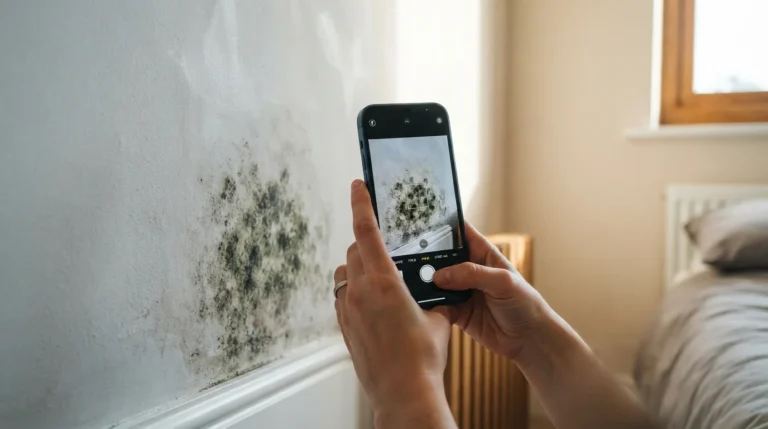

Mould behind the wardrobe in the council house can result from restricted airflow, cold walls, inadequate ventilation, leaks, or a combination of these factors. Shuffling furniture doesn’t establish who is liable. Your council should investigate the underlying cause rather than assume that furniture placement or everyday household activities explain the problem.
The building principles below apply across the UK; the Awaab’s Law deadlines discussed here apply to England. This is general housing information, not a personal appraisal or legal opinion.
Mould behind wardrobe council house: ventilation or defect?
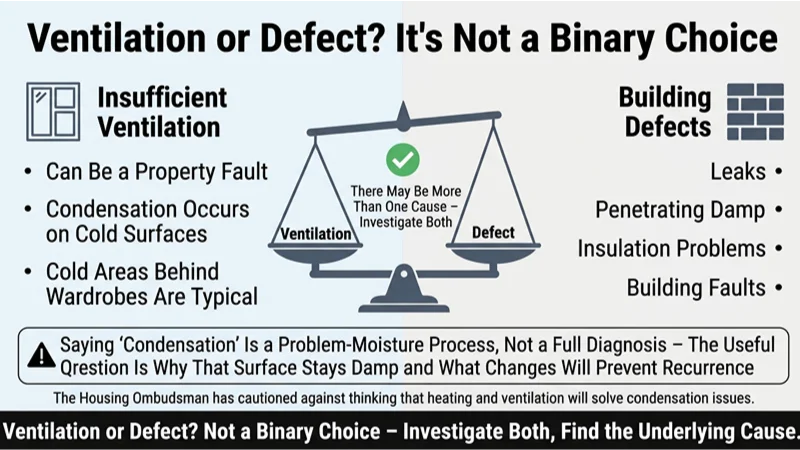
The question presents a false choice. Poor ventilation can itself be a property fault, and condensation can also result from leaks or building defects. Government guidance says the cold wall behind a wardrobe is a typical condensation spot, and a home can have more than one cause at once. Knowing whether it is condensation or damp matters, because the answer decides what your landlord has to fix.
A wardrobe restricts air movement around the wall. Yet calling the result “condensation” is a problem-moisture process, not a full diagnosis. The useful question is why that surface stays damp and what changes will prevent recurrence. The Housing Ombudsman has cautioned against thinking that heating and ventilation will solve condensation issues.
What can the pattern tell you?
These are not diagnoses; they are prompts for investigations. A qualified inspection should consider the whole property.
| Pattern | Possible explanation | Inspection focus | What it doesn’t prove |
|---|---|---|---|
| Mould behind furniture on an external wall | Cold surface and restricted airflow | Insulation, wall temperature, ventilation | Tenant fault |
| Several affected corners | Broader condensation problem | Heating, extraction, building condition | Furniture is the only cause. |
| Damp after rainfall | Possible penetrating damp | Roof, gutters, external fabric | Opening windows will fix it. |
| Local wet patch near pipework | Possible plumbing leak | Supply, waste, and heating pipes | Condensation alone |
| Recurrence after cleaning | Unresolved moisture source | Previous diagnosis and repair effectiveness | A stronger cleaner is needed. |
The distinctions above follow government guidance on condensation, penetrating damp, leaks, and recurring mold.
How to get the cause investigated: 3-step implementation plan.
1. Be sure to capture the pattern first.
Take photographs of the wall, the back of the wardrobe, and the affected belongings, including wider shots showing where they are located. Record when the problem was first noticed, previous reports, and any relationship with rain. Don’t take apart fitted furniture or disturb hidden mould for evidence: doing so releases spores from damaged material. Use photographs to support your investigation, not to replace a suitable inspection.
2. Notify us of any hazardous item, not just messiness.
Use the council’s official repair channel and keep the reference number. Please provide details about the location, who is sick, how long it lasts, what happens when it occurs, etc. Ask about investigating the underlying moisture source and the safety arrangements. Do not wait to get medical evidence before reporting: guidance says landlords should not require it before acting. If the council ignores your report or the problem keeps coming back, you may have a damp and mould claim.
3. Get a diagnosis and follow-up.
Ask for the justification for the explanation and whether the surveyor checked ventilation, insulation, heating, leaks, and external defects. Ask for the work plan in writing. Simply cleaning does not prevent. As per government advice, your surveyor should arrange a further inspection no less than six weeks after the work is done. Further investigations may be required if damp or mould returns.
What should the council do in England?
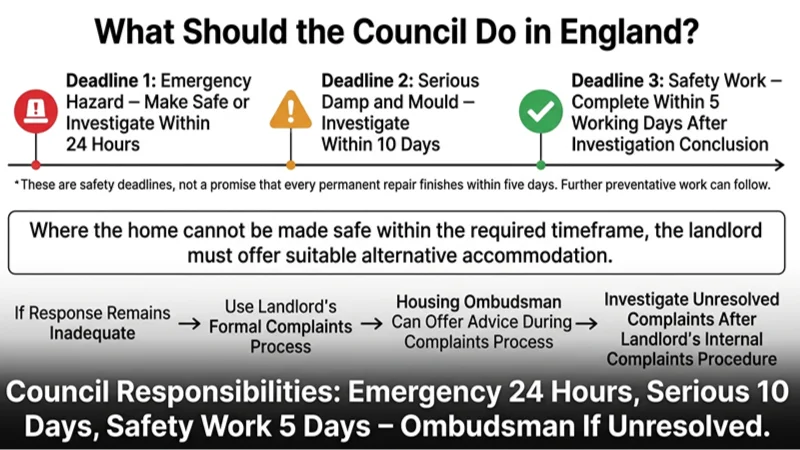
If a landlord becomes aware of any serious damp and mould threats, they must investigate and remedy the situation in 10 days. Safety work must be completed within five working days of the conclusion of the investigation if confirmed. An emergency hazard must be made safe or investigated within 24 hours.
These are safety deadlines, not a promise that every permanent repair finishes within five days. Further preventative work can follow, subject to the law’s requirements. Where the home cannot be made safe within the required timeframe, the landlord must offer suitable alternative accommodation.
If the response remains inadequate, use the landlord’s formal complaints process. The Housing Ombudsman can offer advice during the complaints process and will investigate unresolved complaints after the landlord’s own internal complaints procedure.
FAQ
What Causes Mold to Grow Behind Wardrobes?
According to government advice, condensation often appears on the cold wall surfaces behind wardrobes and sofas. The concealed location can also delay detection. However, location alone cannot tell whether the issue is poor extraction, inadequate insulation, or another source of moisture.
Is poor ventilation the cause of mould behind furniture?
Negative. As per the government guidance, we have highlighted the deficiencies in the building, inadequate ventilation, and condensation. The text further acknowledges that a residence might be affected by multiple damp conditions. A suggestion regarding ventilation may be useful; however, it is not a substitute for investigating water ingress or any other property issues.
Is the council responsible for mould behind my wardrobe?
The council should assess and investigate your report to find the cause, not dismiss it because your furniture is involved. Who pays for repairs and damaged items will depend on the situation. Government guidance in England states that advice to tenants must never replace work to address the underlying causes of damp and mould.
How far off the wall should a wardrobe be?
Improving the airflow around furniture is likely desirable, yet there is no one clearance that will prevent the occurrence in every home. When the wardrobe is fitted or anchored, ask for advice appropriate to the room and furniture. Forming a gap is a remedial measure, not proof of exclusion of an underlying defect.
Will a dehumidifier prevent mold in the closet?
It can be utilized as a temporary measure for safety while the landlord looks into it, but it doesn’t show that it is fixed. The government’s advice to tenants includes, for example, dehumidifiers for temporary assistance while further investigation takes place. Ask how any proposed measure fits into the permanent repair plan.
What if the council only assesses photographs?
In England, Awaab’s Law guidance says you can request a renewed, in-person investigation if the initial assessment was remote and you consider it inadequate. The landlord must investigate within 10 working days of your request. Photographs may not capture hidden damage from rising water or the full extent of damage.
Tips for inspection.
Enquire whether “condensation” is a mechanism or an explanation.
Ask about the proposal’s effectiveness.
Return for a follow-up appointment: a clean surface immediately after treatment is not a fix.
Your next action
Report the mould behind the wardrobe to the council house concerns today, and keep photographs and your repair reference. If the problem isn’t fixed, Housing Repair Solutions can review your case for free. Also read the government’s damp and mould guidance, the Awaab’s Law tenant guidance, and the Housing Ombudsman’s damp and mould resources.