
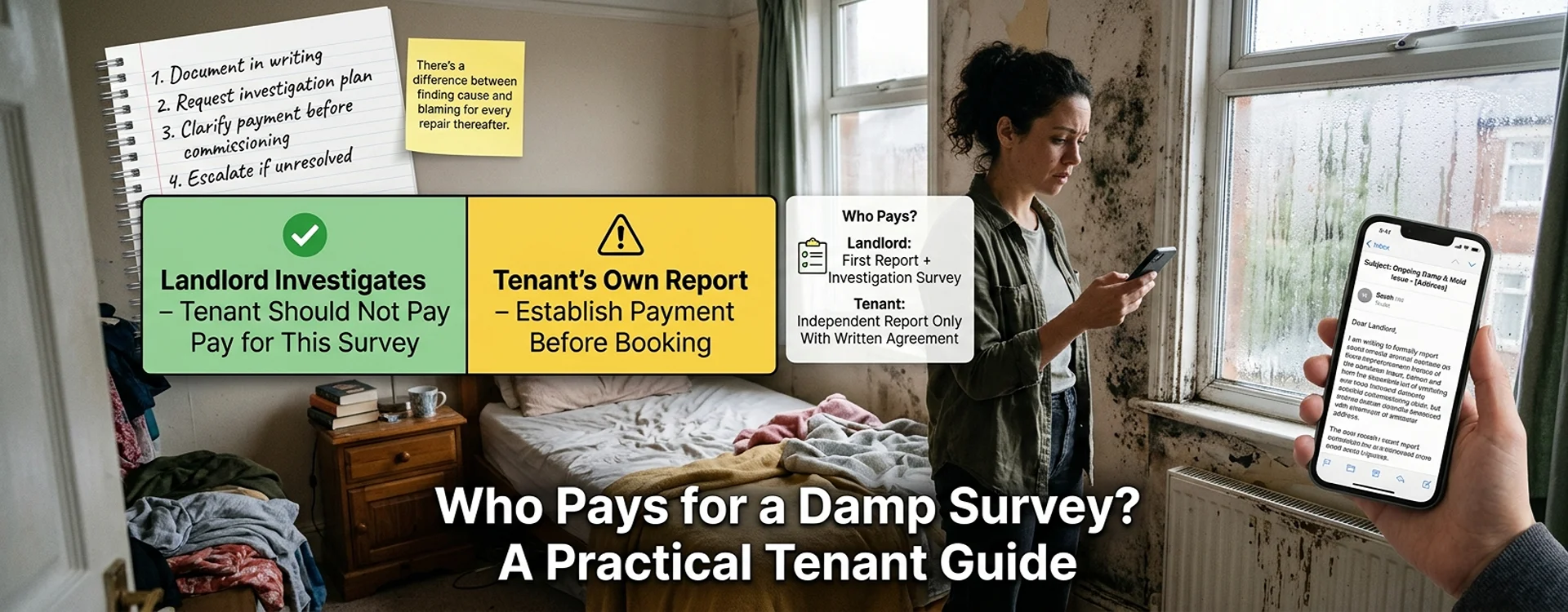
Generally, your landlord pays to investigate damp in your rented home in England. The Shelter states that tenants aren’t liable if the landlord requires a damp surveyor to ascertain the cause. Who pays for a damp survey can be a separate question, but you agree to payment before you book.
This renter’s guide is for use in the UK, but the legal advice applies only in England. It’s advised to check local advice before applying the deadlines in England elsewhere, since Scotland, Wales, and Northern Ireland all have different policies.
Who pays for a damp survey?
The important distinction is who commissions the investigation. A landlord’s duty to investigate does not automatically settle payment for an additional report you order yourself. Shelter’s no-payment advice concerns the surveyor needed for the landlord’s investigation.
| Situation | Who arranges it? | Payment position | What to do |
|---|---|---|---|
| First report of damp | Landlord or agent | Landlord investigates; a specialist may not initially be necessary. | Request an inspection. |
| The cause remains unclear. | The landlord instructs the surveyor. | The tenant should not pay for this investigation. | Ask for findings |
| Council or housing association home | Social landlord | Ask the landlord to investigate through its repairs service. | Report severity and vulnerabilities. |
| The tenant wants another opinion. | Tenant | Establish your payment obligation before instructing. | Get a written quotation. |
| Report sought for a legal dispute | Agree with your adviser | Funding and recovery need separate consideration. | Take advice before booking. |
The landlord investigation obligations are dealt with in the three cases before these cases, while the latter two asked for a commissioning decision that is not automatically reimbursable.
There is a huge difference between finding cause and blaming for every repair thereafter. Before anyone gets the answer, the question must get a specific answer.
What should the investigation establish?
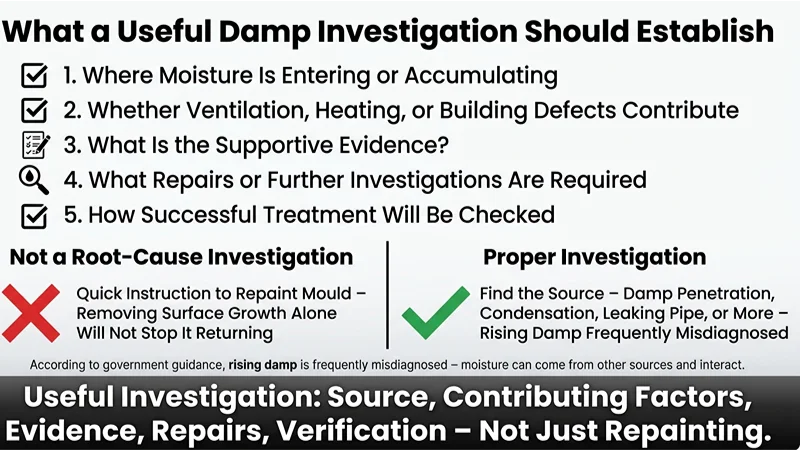
Find out whether the problem is caused by damp penetration, condensation, a leaking pipe, or more. According to government guidance, rising damp is often misdiagnosed, as moisture can come from other sources and interact.
A useful investigation should explain:
-
Where moisture is entering or accumulating.
-
Whether ventilation, heating, or building defects contribute.
-
What is the supporting evidence?
-
What repairs or further investigations are required
-
How successful treatment will be checked.
A quick instruction to repaint mould is not a root-cause investigation. Removing surface growth alone will not stop it from returning.
How to Get a Damp Investigation: 4-Step Implementation Plan
1. Document your concern in writing.
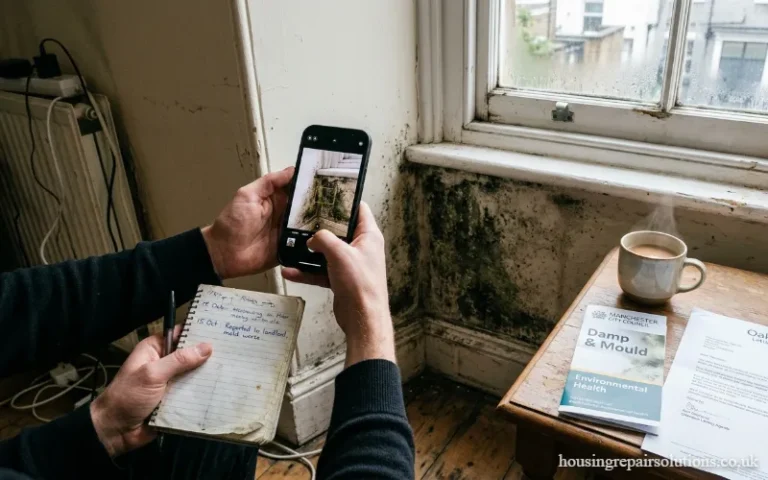
Email your landlord or repair team with dated photos, affected rooms, and when it started. Report leaking pipes, ongoing mould, and vulnerable tenants. Ask for a reference number and an inspection. Do not delay waiting for medical evidence: the government’s guidance states landlords should not wait for this.
2. Request a clear investigation plan.
Inquire as to who will attend, what they will assess, and when findings will be received. Agree on access arrangements and retain appointment messages. If the initial inspection cannot establish the cause, ask whether a damp surveyor will attend. Avoid accepting “it’s condensation” as a complete explanation without investigation.
3. Clarify payment before commissioning another report.
If you would like more objective feedback, we can set a time to discuss your needs and provide a quote. Before instructing your client, ask your landlord if they will arrange or pay for it and what their response is. Never treat a permission to inspect as an agreement to reimburse. Those are two different questions.
4. Escalate through the appropriate route
Private tenants can ask environmental health for help with serious conditions. Council and housing association tenants should use their landlord’s complaints procedure, then, where appropriate, the Housing Ombudsman. Explain what remains unresolved: no inspection, an unsupported diagnosis, missed action, or mould returning after treatment. If the landlord still has not acted, Housing Repair Solutions can review your housing disrepair case for free.
How quickly should the landlord act?
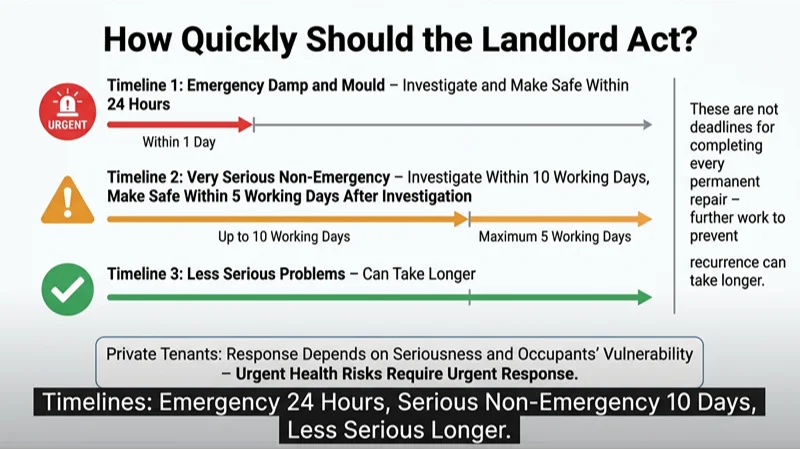
For English social housing, landlords must investigate emergency damp and mould and make it safe within 24 hours. Very serious, non-emergency damp and mould must be investigated within 10 working days, then made safe within five working days after investigation. Less serious problems can take longer.
These are not deadlines for completing every permanent repair. Further work to prevent recurrence can take longer. For private tenants, Shelter says the required response depends on seriousness and occupants’ vulnerability; urgent health risks require an urgent response.
Advice you must read before going.
Photograph the problem before treatment without delay if urgent.
Show the inspector affected areas beyond the most obvious patch.
Outline if and when mould comes back after cleaning or repair.
Don’t just ask for confirmation of work. Ask for a follow-up inspection.
According to the government’s advice, you must document the mould, investigate the cause, and inspect at least six weeks after any remedial work to see if it has returned.
Frequently asked questions
Is it my landlord’s responsibility to arrange a damp survey?
Your landlord must try to establish the cause of reported damp. That doesn’t mean a specialist survey is immediately needed for every report. If the landlord cannot locate the source, then Shelter suggests getting a damp surveyor, which you won’t have to pay for.
Is this true? Could my landlord say the condensation is my fault?
They should investigate the problem rather than dismissing it as condensation. The shelter calls on landlords to ask why a house can’t take the usual activities of cooking and showering. Condensation may arise from poor insulation, ventilation, or heating, but advice to reduce moisture practically should not replace an investigation of the property.
Can I carry out my own independent survey of data?
You can seek a separate professional opinion, but first establish the scope, fee, and any access or testing arrangements. Shelter’s statement that tenants need not pay concerns the surveyor required for the landlord’s investigation. Don’t assume it also promises reimbursement for an additional report you independently choose.
Can I get my damp survey cost reimbursed?
Don’t assume it will happen automatically. Before commissioning a report, request a written agreement and seek housing advice if meant for a dispute. According to the shelter, compensation claims must be supported by evidence, although its guidance makes no assertion that every survey or associated cost contracted independently will be paid for.
Can the council check for damp in their home?
In serious cases, a private tenant can request an inspection by the environmental health department. This doesn’t just replace the survey buyers of a private house might purchase; it looks at conditions that may lead to enforcement. Council tenants should use their landlord’s repairs and complaints routes rather than assume identical enforcement arrangements.
How quickly should a landlord investigate damp?
The investigation should take place within 24 hours for emergency cases and 10 working days for very serious non-emergency cases. The severity determines the timeframe for other cases. Private tenants should report clear health risks, as urgency depends on the condition and vulnerability in the home.
If Mould Returns After Repairs, What Next?
Submit it again along with the photos and old reference. The government advises at least a six-week inspection after remedial work. If it recurs, look deeper and intervene; do not just re-treat. An unresolved leak, ventilation problem, or interacting moisture source may remain.
Your next action
First, ask your landlord to investigate and determine who pays for a damp survey. Request an appointment, analysis, and repair strategy in written form. Before buying a report, agree on its scope and fee. If your council or housing association keeps ignoring the request, you may be able to bring damp and mould claims.