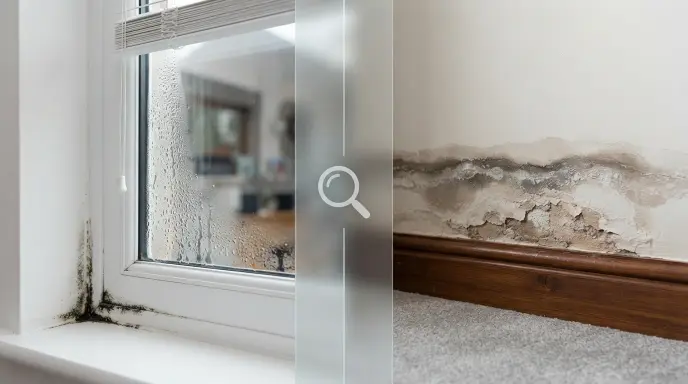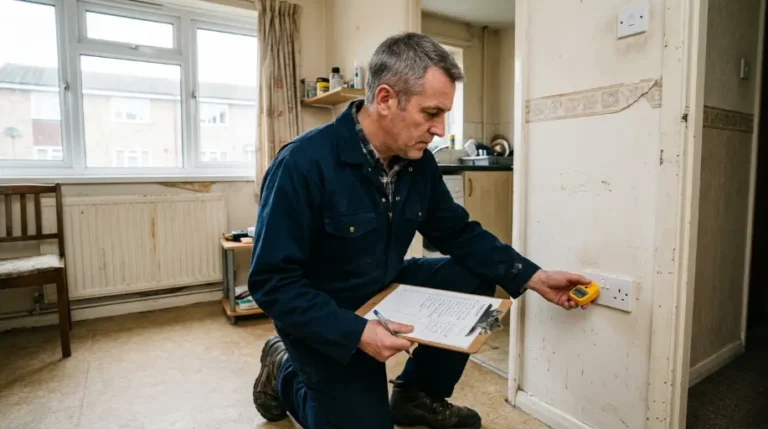

Living with damp and mould in a rented home is not just unpleasant — it is a legally recognised health hazard, and in most cases, it is your landlord’s responsibility to fix it. Whether you rent from a private landlord, a housing association, or the council, UK law gives you clear and enforceable rights.
This guide breaks down exactly what those rights are, what the NHS says about the health risks, and the precise steps you can take — right now — if your landlord is ignoring the problem.
Quick Reference: Tenants’ Rights for Damp and Mould in the UK
| Your Right | Legal Basis | Applies To |
|---|---|---|
| Live in a home free from damp and mould hazards | Homes (Fitness for Human Habitation) Act 2018 | Private and social tenants |
| Landlord must repair structural causes of damp | Section 11, Landlord and Tenant Act 1985 | All rented properties |
| Request an Environmental Health inspection | Housing Act 2004 / HHSRS | Private and housing association tenants |
| Landlord must investigate within 14 days (social housing) | Awaab’s Law (November 2024) | Social housing tenants |
| Landlord must begin repairs within 7 days of investigation (social housing) | Awaab’s Law (November 2024) | Social housing tenants |
| Claim compensation for damaged belongings and health impacts | Homes Act 2018 / Housing Act 2004 | All renting tenants |
| Protection from retaliatory eviction after reporting repairs | Deregulation Act 2015 | Private tenants in England |
What Does UK Law Say About Landlord Mould Responsibility?
The law on this is clear. Landlords cannot simply blame tenants for damp and mould, paint over the problem, or fob you off with a dehumidifier and call the job done.
Under Section 11 of the Landlord and Tenant Act 1985, every landlord in England and Wales — private or social — is legally required to keep the structure and exterior of the property in good repair. This includes the roof, walls, guttering, windows, and plumbing. When any of these fail and cause damp, the responsibility to fix it sits firmly with the landlord.
Going further, the Homes (Fitness for Human Habitation) Act 2018 requires that every rented property is safe and fit for human habitation throughout the entire tenancy — not just on the day you move in. Under this Act, “freedom from damp” is explicitly listed as one of the conditions a home must meet. If your home fails that standard, you can take your landlord to court directly, without needing to involve the council first.
The Housing Act 2004 introduced the Housing Health and Safety Rating System (HHSRS), a risk-based framework local councils use to assess health and safety hazards in residential properties. Damp and mould growth is classified as a defined hazard under the HHSRS. If an Environmental Health Officer (EHO) inspects your home and identifies it as a serious Category 1 hazard, the council is legally required to take enforcement action against your landlord — including issuing an improvement notice.
If you are a tenant and your landlord has failed to act on damp or mould complaints, you may already have a valid housing disrepair claim. Understanding your rights is the first step toward getting the repairs — and compensation — you are entitled to.

Awaab’s Law: A Game-Changer for Social Housing Tenants
In November 2024, Awaab’s Law came into force for social housing providers in England. It was introduced following the tragic and preventable death of two-year-old Awaab Ishak, who died from a severe respiratory condition caused by prolonged exposure to black mould in his social housing flat in Rochdale.
The law creates strict, time-bound legal obligations for social landlords:
- Investigation deadline: Social landlords must begin investigating any report of damp or mould within 14 days of a complaint.
- Repair deadline: Once the investigation is complete, urgent repairs must begin within 7 days.
- Hazard removal: Emergency hazards must be dealt with within 24 hours.
If your social housing landlord — whether a housing association or local council — fails to meet these timescales, you have legal grounds to escalate the matter to the Housing Ombudsman and to seek compensation.
Awaab’s Law does not yet formally apply to private landlords, but the government has signalled its intention to extend similar protections to the private rented sector. Practically speaking, the law has already set a new benchmark — any landlord, private or social, who ignores damp and mould reports faces increasing legal and regulatory pressure.
What the NHS Says About Damp and Mould Health Risks
Many tenants are not fully aware of just how seriously the NHS and UK government health agencies view damp and mould. This is not a cosmetic issue — the health consequences are well-documented and, in vulnerable individuals, can be severe.
According to NHS guidance and the joint guidance published by the UK Health Security Agency and the Ministry of Housing, Communities and Local Government, damp and mould exposure is directly linked to:
- Respiratory infections — including pneumonia and bronchitis
- Asthma — both triggering new cases and worsening existing conditions
- Allergic reactions — including persistent sneezing, skin rashes, and red, itchy eyes
- Weakened immune system — making people more vulnerable to colds and flu
- Fatigue, headaches, and difficulty concentrating — particularly with prolonged exposure to mould spores
- Mental health impacts — anxiety and depression linked to poor, unstable living conditions
The NHS specifically identifies certain groups as being at significantly higher risk: children, the elderly, pregnant women, and anyone with a pre-existing respiratory condition such as asthma or chronic obstructive pulmonary disease (COPD).
The NHS recommends keeping rooms you use regularly at a minimum of 18°C to prevent condensation building up on cold walls and surfaces. This is a guidance point worth sharing directly with your landlord — if your heating system is inadequate to reach this temperature, the landlord has a duty to fix it.
If you or anyone in your household has developed or worsened a health condition that you believe is linked to damp or mould in your rental property, a note from your GP becomes a powerful piece of evidence. It strengthens any damp and mould compensation claim significantly and can fast-track intervention by Environmental Health.
Who Is Responsible: Landlord vs Tenant — Knowing the Difference
One of the most common tactics used by landlords to avoid responsibility is blaming the tenant’s “lifestyle” for the damp. In our experience working with tenants across the UK, this happens constantly — and it is not always justified.
Here is a clear breakdown of responsibility:
Landlord Mould Responsibility (Landlord Must Fix)
| Issue | Why the Landlord Is Responsible |
|---|---|
| Rising damp from ground (failed or absent DPC) | Structural defect — Section 11, Landlord and Tenant Act 1985 |
| Penetrating damp from leaking roof, gutters, or walls | Structural / exterior maintenance obligation |
| Damp caused by faulty or absent extractor fans | Landlord is responsible for installed ventilation systems |
| Damp from leaking pipes or plumbing behind walls | Landlord’s duty to maintain plumbing and water installations |
| Condensation due to inadequate insulation or single glazing | Property design failure — Homes (Fitness for Human Habitation) Act 2018 |
| Black mould in a rental property caused by design defects | Homes Act 2018 — property must be fit for habitation |
Tenant Responsibility (Tenant Should Manage)
| Issue | Why It Falls on the Tenant |
|---|---|
| Condensation from never opening windows in a well-ventilated property | Reasonable day-to-day maintenance |
| Drying wet clothes on radiators without any ventilation | Contributing to excess moisture |
| Never using extractor fans provided by the landlord | Failure to use available facilities |
| Keeping heating too low despite having a functional heating system | Tenant’s decision, not a structural defect |
The key legal principle is this: if the property cannot manage normal, everyday levels of moisture produced by a reasonable number of occupants — because of poor insulation, inadequate ventilation, or structural faults — that is the landlord’s problem, not yours.
Mould in a Rental Property: Your Step-by-Step Action Plan
If you have discovered mould in a rental property, take these steps in order. Each one builds your legal position.
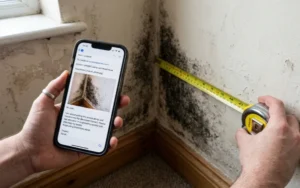
Step 1 — Document everything before you clean or touch anything. Photograph every affected area with clear, date-stamped images. Take wide shots showing location and close-ups showing severity. Do this on day one — evidence gathered early is the most powerful.
Step 2 — Report it to your landlord in writing immediately. Email is best — it creates an automatic date-stamped paper trail. Describe the problem clearly, attach your photographs, and state that you expect a written response with a repair plan. Reference your rights under the Homes (Fitness for Human Habitation) Act 2018. Keep every message you send and every reply you receive.
Step 3 — Give a reasonable response window — and document the silence. What counts as reasonable depends on urgency. A leak causing active damp warrants 24–48 hours for an initial response. Non-emergency structural repairs warrant 2–4 weeks. If your household includes children, elderly residents, or anyone with a respiratory condition, make this clear — it increases the urgency of the landlord’s legal obligation.
If you are experiencing common housing disrepair issues in a council or housing association property — including damp, mould, or structural problems your landlord is refusing to address — you have the right to formal action.
Step 5 — Contact the Housing Ombudsman (social housing tenants). If you rent from a housing association or council and your landlord has not met the Awaab’s Law timescales or is failing to resolve the issue through internal complaints, the Housing Ombudsman can investigate and order compensation for stress, inconvenience, and delay.
Step 6 — Consider a formal housing disrepair claim. If the problem has caused health issues, damaged your belongings, or made your home genuinely unfit to live in, you have the right to pursue a legal claim for compensation. Under the Homes Act 2018, you can take your landlord to court directly for failure to maintain a habitable property.

Can You Sue Your Landlord for Mould? What Compensation Looks Like
Yes — suing your landlord for mould and damp is a legitimate and increasingly common course of action in the UK. You can pursue compensation for:
- Property damage — furniture, clothing, electrical items, and personal belongings damaged by damp or mould
- Health impacts — respiratory illness, worsened asthma, allergic conditions, and other mould-related health problems
- Financial losses — loss of earnings if your health caused you to miss work; medical costs including prescriptions
- General damages — compensation for inconvenience, distress, and reduced enjoyment of your home
Compensation amount guidance (UK):
| Severity of Claim | Typical Compensation Range |
|---|---|
| Minor — cosmetic damage, short-term inconvenience | £250 – £1,500 |
| Moderate — repeated failures, property damage, mild health impact | £1,500 – £5,000 |
| Serious — significant health impacts, extended disrepair period | £5,000 – £15,000+ |
| Severe — major injury, long-term respiratory illness, children affected | £15,000+ |
The limitation period for housing disrepair claims is generally 6 years from the date the landlord failed to act. For personal injury claims linked to mould exposure, the limitation period is 3 years from when you became aware the health problem was caused by your living conditions. If you think your limitation period may be approaching, seek advice as soon as possible.
Many tenants worry about the cost of pursuing a claim. The good news is that no win no fee housing disrepair solicitors take on cases without any upfront fees — you only pay if you win.
What Landlords Cannot Do (Your Protections Against Retaliation)
Some landlords respond to repair complaints by attempting to evict the tenant — a practice known as retaliatory or revenge eviction.
Under the Deregulation Act 2015, private tenants in England have legal protection against this. If you have properly reported a repair issue in writing, and an Environmental Health Officer has been involved in relation to that issue, your landlord cannot legally serve you a Section 21 no-fault eviction notice for a period of six months after the EHO’s involvement.
This protection means you should not stay silent out of fear. Report the problem, keep your records, and know that the law is on your side.
At Housing Repair Solutions, we help tenants across the UK hold landlords, housing associations, and councils accountable for damp, mould, and all forms of housing disrepair — entirely on a no win, no fee basis. If your landlord is refusing to act, you do not have to accept it.