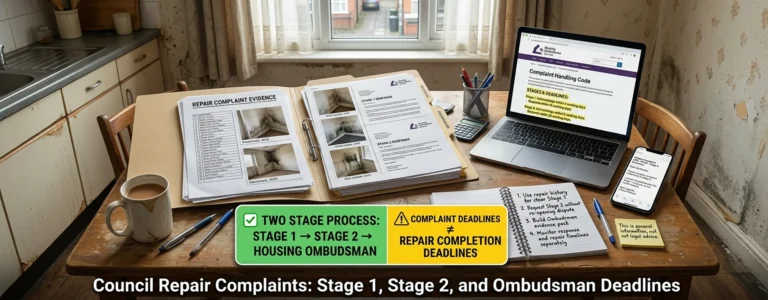

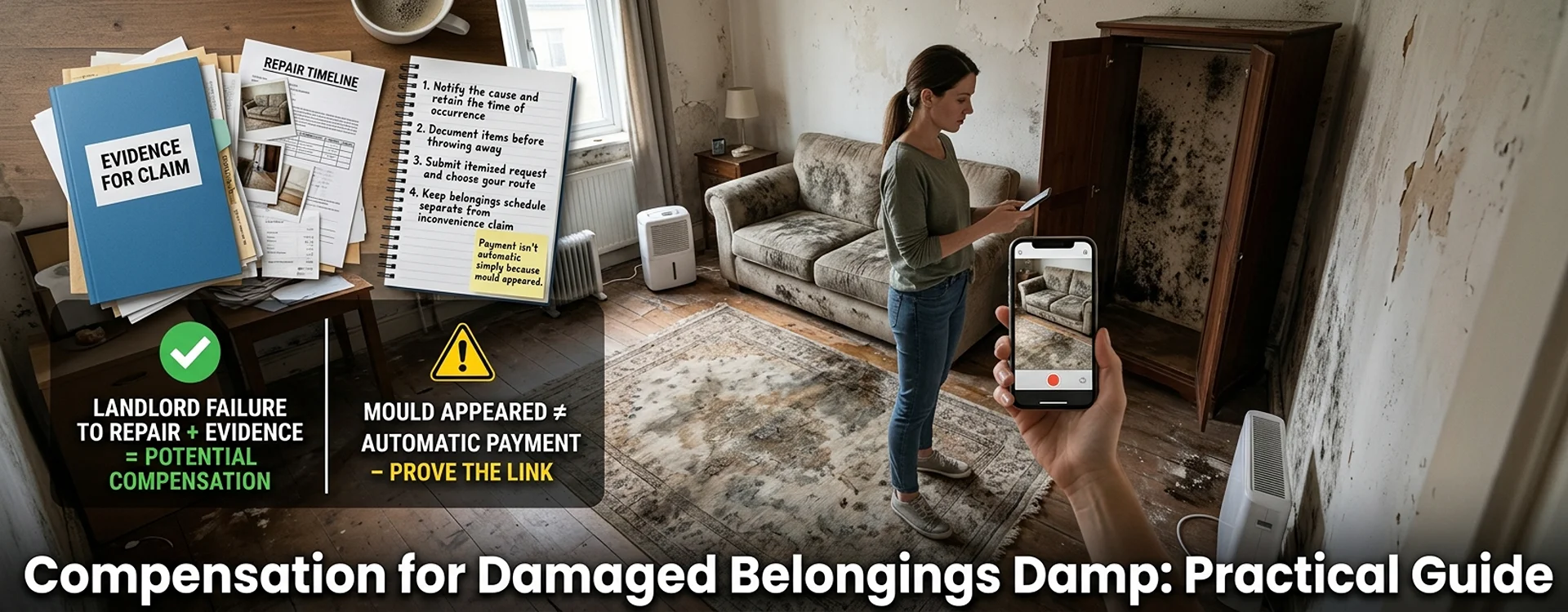
You can claim compensation when damp ruins your furniture, clothes or carpets and the cause is your landlord’s failure to meet their obligations. Two things decide whether it works: evidence linking the damage to that failure, and a sensible valuation. If you’ve been searching “compensation for damaged belongings damp,” know this much up front. Mould turning up doesn’t mean a payout follows automatically.
This guide is written for UK renters, but the legal detail and the Housing Ombudsman route below apply to England only. Get advice specific to your nation if you live elsewhere. What follows is general information, not personal legal advice.
When can a landlord be responsible for damage?
It comes down to the landlord’s duties on disrepair and unfit homes in England. If you want to make a successful damp and mould compensation claim for your belongings, photos of the mould won’t carry you. Your reports and messages have to show what the landlord knew, and when.
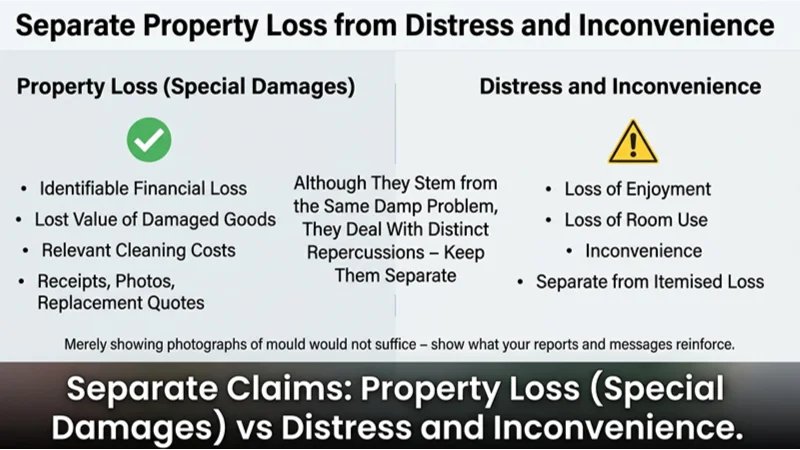
Keep property loss apart from distress, inconvenience and loss of use of a room. The same damp problem causes all of them, but each one is a different kind of harm.
Compensation for damaged belongings damp: estimate your loss
Nobody pays a fixed sum per sofa, wardrobe or bag of clothes. In a court claim you can include “special damages”, meaning an identifiable financial loss. That covers the lost value of damaged goods and any relevant cleaning costs. A second-hand item isn’t worth its original price, so justify the figure you put down. If the damage began in a bedroom, our guide on mould behind a wardrobe in a council house is worth a look.
The table below shows what to gather for each item when you build your schedule of loss.
| Item | Record the damage | Support ownership and value | Explain the amount requested |
|---|---|---|---|
| Sofa | Whole-item and close-up photos | Receipt, model, age | Cleaning quote or comparable replacement |
| Clothing | Individual items, not just bags | Orders, labels, earlier photos | Itemised loss or cleaning cost |
| Mattress | Damage and room location | Purchase record, approximate age | Replacement quote and reason |
| Tenant-owned carpet | Affected area and underlay | Installation invoice | Cleaning or replacement quotation |
| Wardrobe | Panels, backing and contents | Receipt or bank record | Repair quote or comparable item |
Treat these as evidence suggestions, not guaranteed recoverable amounts. What you’re really trying to prove is the loss itself and its link to the landlord’s failure.
3-step implementation plan to build your claim
1. Report the cause and record the timeline
Write to your landlord reporting the damp and asking for it to be investigated and repaired. Say which rooms are affected, when you first noticed it and which possessions have been damaged. Hang on to repair references, inspection reports and any missed appointments. A photo proves what condition something was in. It doesn’t necessarily prove when the landlord found out or how the damage happened.
2. Document every item before it goes in the bin
Photograph each item, the damage itself and where it sits in the room. Jot down who owns it, how old it is, what it cost and whether you still have the receipt. Before you throw anything away, ask the landlord or their insurer what evidence they’ll want and whether they need to inspect it. One snap of several bin bags won’t establish what was inside or what it was worth.
3. Send an itemised request and pick your route
Give your landlord the timeline, the proof and the remedy you’re asking for, then request a written decision on any items they dispute. For English social housing, go through the landlord’s complaints process before contacting the Housing Ombudsman. Get advice before starting any court action, too, because the Ombudsman can’t look at the same issue once proceedings begin. Want someone to go over your evidence first? Housing Repair Solutions can assess your case.
Complaints and insurance go different ways
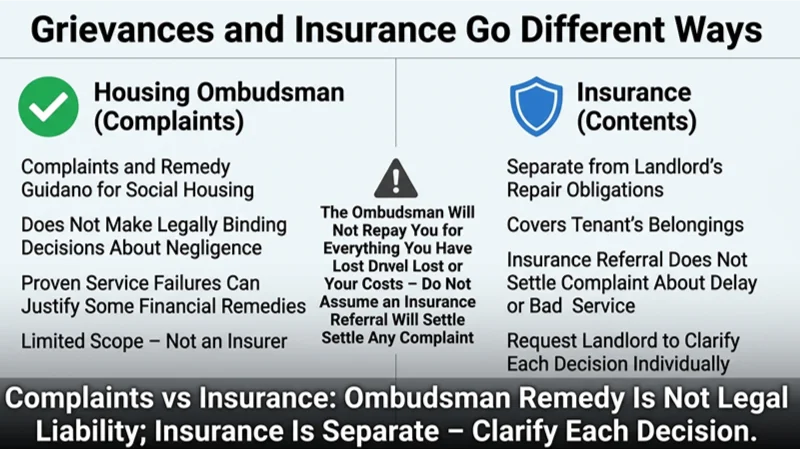
Choosing a cover route is one question. Whether the landlord handled repairs and complaints properly is another. The Housing Ombudsman’s remedies guidance for social housing explains that it doesn’t make legally binding rulings on negligence the way a court does. Even so, service failures that are proven can justify some financial remedies.
Don’t expect it to repay everything you’ve lost, or your costs. And being sent to an insurer won’t settle a complaint about delay or poor service. Ask the landlord to explain each decision separately.
Tips for preparing your claim
- Stick to documents. Personal casework stories from other people aren’t a practical check on your own claim.
- Keep your belongings schedule and your inconvenience compensation request in separate documents.
- Work out who owns each carpet and piece of furniture.
- Take photos both before and after any repair attempt.
- Back every amount you ask for with evidence or a reasonable estimate.
- Make the chain easy to follow: the unrepaired failure, what it caused, and the remedy you want.
Frequently asked questions
Can I get compensation for possessions that were damaged by damp?
Possibly. You’ll need proof that the landlord’s neglect caused the damage, and mould on its own doesn’t show that. Gather repair notifications, inspections, photos and an itemised list of losses. Whether you’re owed anything depends on the legal basis of your claim and the circumstances.
How much can I get for damaged furniture?
There’s no standard award for furniture. Give the item’s age and condition, the damage, the loss in value, and quotes for cleaning or replacement. Keep this figure out of any inconvenience claim. Money for things follows the actual financial loss you can prove, not an automatic rate.
Can I claim without receipts?
You can still put in a request, though ownership and value get harder to prove. Proof of purchase doesn’t have to be the original receipt, so think creatively: bank statements, order emails, old photos. Be honest about anything that’s an estimate. Evidence of the damaged item and of the financial loss that followed will matter most.
Is my landlord required to replace damaged carpets?
That turns on who owns the carpet. If it’s yours, it belongs on your inventory schedule. If the landlord supplied it, repair or replacement is a separate issue. Shelter says landlords should make good damage caused by damp, damaged carpets included. Establish proof of ownership before you ask for payment.
Can I claim if I don’t have contents insurance?
No insurance doesn’t create a landlord’s liability, and it doesn’t remove it either. Even where the landlord was negligent or in breach of duty, you still have to provide proof. An insurance route and a complaint route do different jobs, so ask whoever referred you why you’re being sent to an insurer, and whose policy it is.
Should I throw out ruined items right away?
Document them first where you can, and ask promptly what inspection evidence is needed. If they do have to go, keep disposal records and photos. Gathering evidence isn’t the same as hoarding ruined belongings for good. The aim is to prove your loss without adding to the mess or the cost.
Will the Housing Ombudsman pay for my belongings?
Not by default. It doesn’t decide negligence or liability like a court, and it doesn’t act as an insurer. Where maladministration is established, its remedy guidance may allow for actual costs depending on the circumstances. Its reach over insurers is limited, too.
What should you do now?
To get paid for damaged belongings damp, start with three documents: a repair timeline, an itemised loss schedule and the evidence behind it. Shelter’s templates for damp complaints can help you organise the writing.