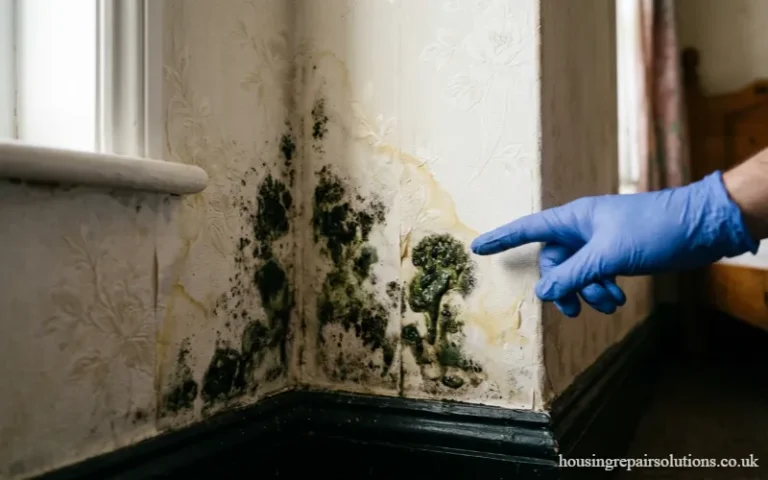

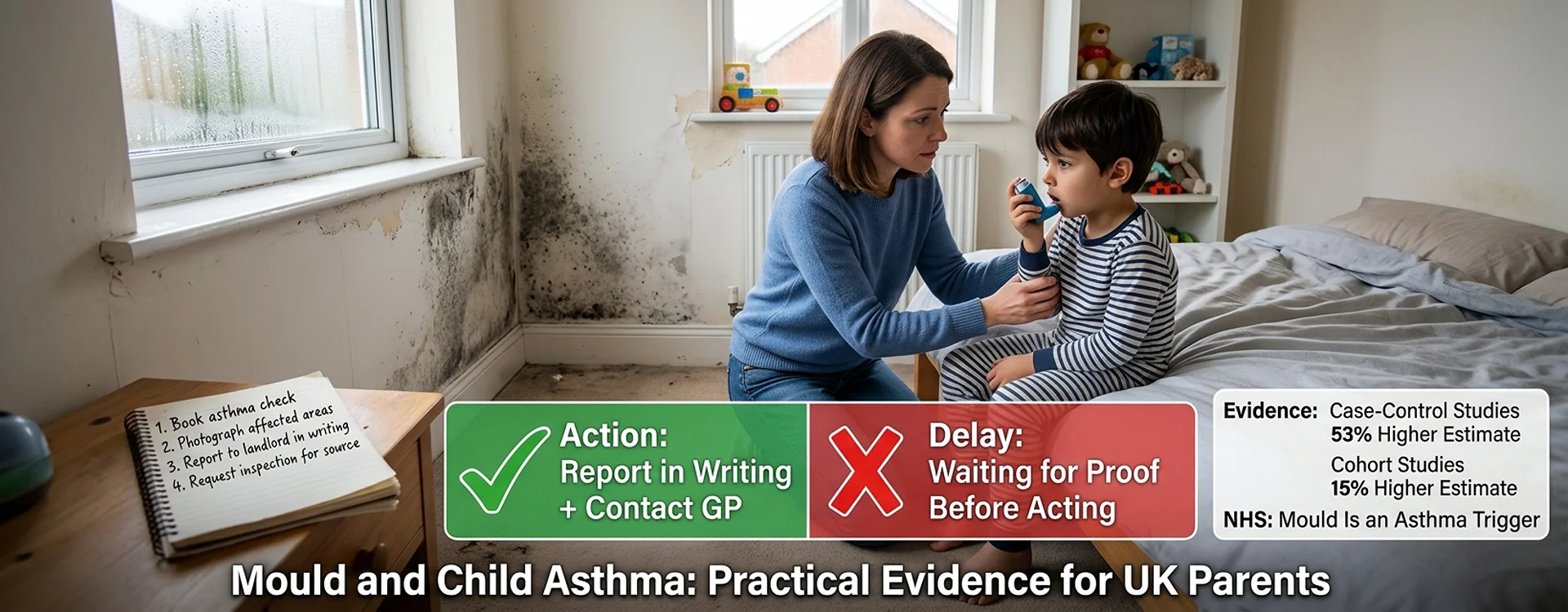
Mould and dampness could actually trigger asthma in children. Younger children living in mouldy settings are more likely to develop asthma. Mold exposure in very young children does not explain cognitive deficits, as test scores show. If you’re exposed to moisture through inhalation, the best clinical treatment is for asthma. The above shouldn’t be a substitute for professional medical advice
Mould and child asthma: what the evidence shows
Will being exposed to mould cause asthma to develop? Could mould make asthma worse? These are the two questions worth asking. Mould has been identified as an asthma trigger.
Contact with rain can cause dampness, which can then lead to mould and dust spores. Visible mold is not the only significant exposure; dampness may benefit house dust mites as well.
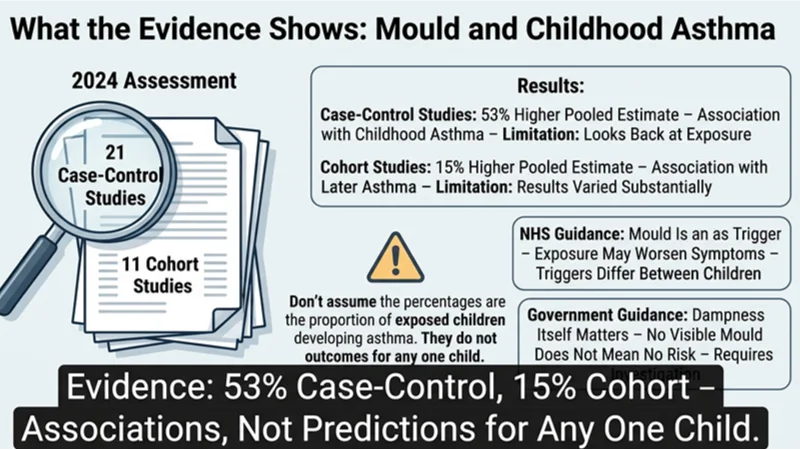
In 2024, an assessment evaluated 21 case-control studies and 11 cohort studies on mould exposure and childhood asthma.
| Evidence | Finding | Interpretation | Important limitation |
|---|---|---|---|
| Case-control studies | 53% higher pooled estimate | Association with childhood asthma | Looks back at exposure |
| Cohort studies | 15% higher pooled estimate | Association with later asthma | Results varied substantially. |
| NHS guidance | Mould is an asthma trigger. | Exposure may worsen symptoms. | Triggers differ between children. |
| Government guidance | Dampness itself matters. | No visible mould does not mean no risk. | Requires investigation |
The meta-analysis, NHS asthma guidance, and government damp and mould guidance.
Don’t assume the percentages are the proportion of exposed children developing asthma. Nor do they predict the outcomes for any one child. Although studies provide evidence sk a potential association, multiple influences vtkaak rukkwo, sak research wrddrhx avvp.
You do not need proof that mould caused your child’s asthma before dealing with an unhealthy house. According to the UK government guidance for England, landlords shouldn’t wait for the medical evidence before acting on damp and mould. Where a child’s health has been affected, a personal injury housing disrepair claim is a separate legal route, and GP records will usually be needed to support it.
Help needed for breathing problems.
If your child wheezes, coughs persistently, has difficulty breathing, wakes up at night, or experiences symptoms while taking medication, consult your doctor. Consider using an inhaler. Coughs may be related to mould but do not blame all coughs on it. Check moisture.
Call 999 during an asthma attack.
If your child becomes worse during an asthma attack or does not improve after taking the maximum reliever dose in their plan, call 999. Also, call if your child has no asthma inhaler. Stay with the instructions that will be discussed in your individual asthma action plan.
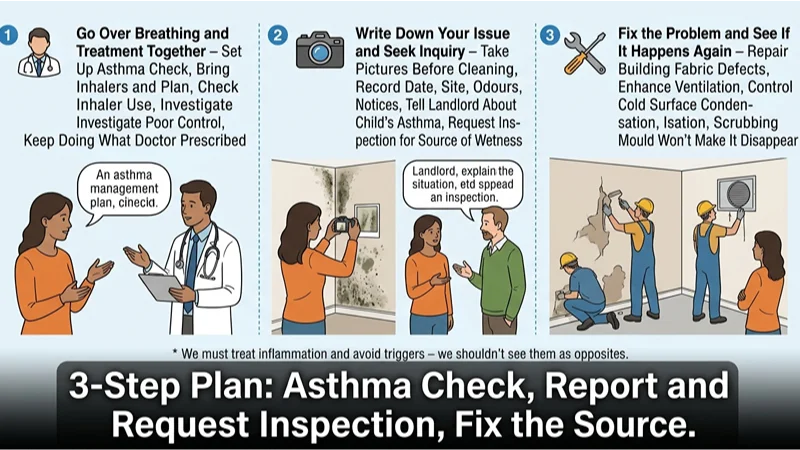
A 3-Step Plan for Minimising Exposure.
1. Go over the breathing and treatment together.
Schedule a meeting for an asthma check, and bring the child’s inhalers and plan. Have the clinician check inhaler use and investigate factors contributing to poor control. Keep doing what your doctor prescribed while the repairs are done. We must treat inflammation and avoid triggers; we shouldn’t see them as opposites.
2. Write down your issue and seek inquiry.
Before cleaning, take pictures of the affected areas. Also record the date, location, odours, and any prior notices. Let the landlord know that a child has asthma. Request an inspection to determine the source of the wetness, rather than a paint job. Images can show circumstances but can’t show what lies beneath or how moist it is.
3. Fix this problem and see if it happens again.
Renovations may include repairing defects in the building fabric, enhancing ventilation, or controlling the formation of cold surfaces (which are susceptible to condensation). Scrubbing away a patch of mould will not make the problem disappear. If the landlord keeps delaying repairs, Housing Repair Solutions offers a free case review for council and housing association tenants.
Little details that humans tend to neglect.
Supported by knowledge and proof.
If you smell something musty and notice no growth in your home, it likely means you have mould behind wallpaper, furniture, or another surface. Before stripping materials, check whether spores are released. Like a “drip” above, the material’s ability to let moisture pass. Rather than simply approving the surface finish, inquire about the problem’s cause and how the work addressed it. Note barriers that might include unaffordable heating or unsafe window openings. The given words must be used in the question.
FAQS
Can mold give kids asthma?
Children who live in a mouldy house are likely to develop asthma later in life. Furthermore, if someone already has asthma, mould is one of the main causes of asthma. Being around a virus does not guarantee one will get infected, or in this case, a child will. It is impossible to single out a cause for allergic diseases. Allergies, family history, and other environmental effects also play a role; therefore, one cannot attribute the cause of the illness to exposure alone.
What are the signs of mould affecting my child?
If your breath is short, your chest feels tight, and you’re coughing and wheezing, seek help. That is the case particularly if it is interrupting your sleep or everyday activities. However, these do not mean a person is definitely dealing with mould. Bring these home circumstances to the attention of the GP, along with any physical symptoms being experienced, medication being taken, and other possible triggers. This helps the child receive an appropriate assessment. You can read more about the symptoms of mould exposure in UK homes.
Is black mould worse than any other mould?
Don’t rely on color to determine if it’s mold. Don’t wait for damp, mould, smell, or visible growths. Follow government advice and take action now. Initially assess whether the growth may pose a health risk, remove the mould safely, and correct the conditions that allow it to grow.
Can eliminating mould fix my child’s asthma?
Taking away a trigger can lessen the exposure, but you won’t be cured. According to the NHS, asthma is a condition that currently cannot be cured, but the symptoms can be well controlled. Do not decrease medications without advice from the child’s care team; keep up treatment and plan a review.
Is my child allowed to sleep in a bedroom that has mould?
It is better to not leave an asthmatic child unattended while he has asthma. If your symptoms are getting worse, seek housing and medical advice. As per Government guidance, when health concerns arise, landlords must consider suitable alternative accommodation, but in some cases, moving may not be the safest or most appropriate option.
Should I get a mold test in advance of repairs?
Typically not. England’s guidance states that visible mould, a mould smell, or water damage should clearly trigger action. A pro might have to go in to determine the cause, but that doesn’t mean tenants have to prove a specific species of mould before the landlord will take the report seriously.
What proof should you give your landlord?
Provide dated photos of the affected rooms. Reference previous reports, and include details about moisture growth or damage that has occurred again. Mention that a child with asthma lives on the property. Expertise on health and risk may help explain susceptibility but is not required for taking action.
What to do today
For concerns about mould and child asthma, take two parallel actions: contact the child’s care team about symptoms and report the housing problem in writing. Use the NHS asthma guidance and government damp-and-mould guidance as starting points; the housing guidance discussed here applies to England, not every UK nation