
This guide answers the questions that most UK tenants type into search engines at their lowest point: Can I sue my landlord for emotional distress? Can I sue my housing association for negligence? What happens if I have already moved out? And — most importantly — how much compensation can I actually claim?
The answers are more straightforward than you might expect, and the law sits firmly on your side.
Quick Answer: When Can You Sue Your Landlord or Housing Association?
| Situation | Legal Route | Can You Sue? | Time Limit |
|---|---|---|---|
| Landlord ignores repairs causing health deterioration | Housing disrepair + personal injury | Yes | 3–6 years |
| Landlord causing emotional distress through neglect | General damages / psychiatric injury | Yes — with medical evidence | 3–6 years |
| Housing association negligence causing injury or illness | Negligence under Defective Premises Act 1972 | Yes | 3 years (PI) / 6 years (disrepair) |
| Landlord harassment or threatening behaviour | Protection from Harassment Act 1997 | Yes | 6 years |
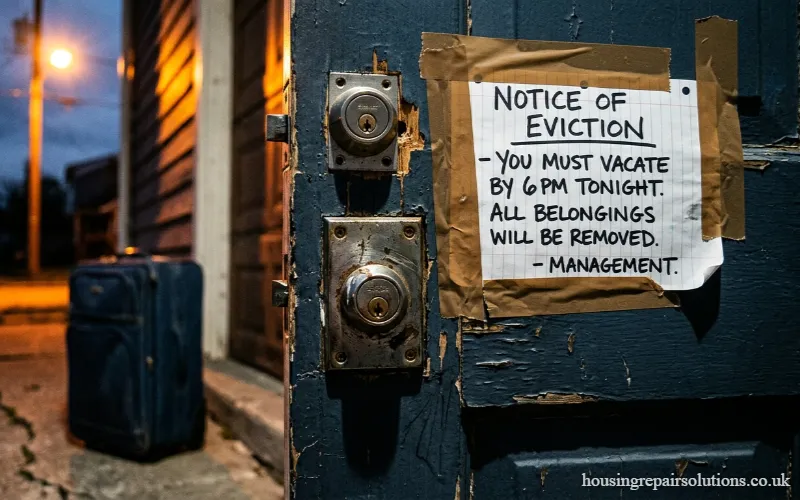
| Illegal eviction causing psychological harm | Protection from Eviction Act 1977 | Yes | 6 years |
| Claim after you have already moved out | All of the above — still valid | Yes | 6 years from when landlord should have acted |

What Does It Mean to Sue a Housing Association for Negligence?
Negligence is a specific legal concept — and understanding it clearly separates strong claims from weak ones. To successfully sue a housing association for negligence, you need to establish four elements. Courts refer to these as the four “pillars” of a negligence claim, and your solicitor builds the entire case around proving each one.
First — Duty of care. Housing associations owe every tenant a legal duty of care. Specifically, they must ensure that the property they rent out meets minimum standards of safety, habitability, and structural integrity. This duty arises from their position as landlord and from legislation including the Landlord and Tenant Act 1985, the Defective Premises Act 1972, and the Homes (Fitness for Human Habitation) Act 2018. Because this duty exists automatically as part of the tenancy relationship, tenants never need to prove it — the law establishes it for them.
Second — Breach of that duty. A breach occurs when the housing association fails to act as a reasonable landlord would. Ignoring repair requests, failing to investigate reported hazards, missing their own repair appointments, or dismissing complaints without investigation all constitute a breach. Furthermore, housing associations that apply a blanket “condensation” explanation to every damp problem without proper investigation regularly breach their duty of care in a documentable and legally significant way.
Third — Causation. This is where many cases require careful legal crafting. You need to show that the housing association’s breach directly caused the harm you suffered — not that the harm simply occurred around the same time. For example, a GP or consultant’s report linking a child’s asthma diagnosis to documented mould exposure in the property establishes causation clearly. Without this causal link, even a clear breach may not produce a successful claim.
Fourth — Damage. Finally, you must show that you actually suffered harm as a result. This covers physical injury, psychological harm, financial losses, and damage to property. Importantly, you do not need to suffer all of these — a single documented category of damage suffices, provided you prove the causal chain.
To understand the full range of issues that housing associations routinely fail to address — and that regularly form the basis of successful negligence claims — our guide to common housing disrepair issues in council and housing association properties sets out every qualifying category in detail.
Landlord Causing Emotional Distress UK: How the Law Recognises Psychological Harm
Many tenants underestimate this area of law because emotional suffering feels intangible compared to a broken leg or a mould-covered wall. UK courts, however, recognise psychological injury as a compensable harm — and in housing cases, the emotional distress flowing from prolonged neglect often exceeds the physical damage in financial value.
The law does not require you to diagnose yourself. Rather, it requires you to demonstrate that the landlord’s conduct caused a recognised psychiatric condition — not simply unhappiness or temporary frustration. Conditions that consistently meet the legal threshold include:
- Generalised anxiety disorder — persistent, disproportionate worry directly linked to housing insecurity or living conditions
- Clinical depression — low mood, loss of motivation, withdrawal from daily life caused or significantly worsened by the home environment
- Post-traumatic stress disorder (PTSD) — particularly where flooding, structural collapse, or other acute traumatic events caused by neglect triggered the condition
- Insomnia and sleep disturbance — documented through a GP’s notes, particularly relevant in cases of persistent noise from disrepair (such as dripping, draughts, or vermin)
- Adjustment disorder — a diagnosable response to a specific stressor, such as prolonged homelessness caused by illegal eviction
A more detailed breakdown of how psychological injury claims work in a housing context — including how courts assess severity and what evidence carries most weight — appears in our dedicated guide to suing for emotional distress under UK housing law.

How Much Can You Sue Your Landlord for Emotional Distress?
This is the question most tenants ask first — and understandably so. The honest answer is: it depends significantly on severity, duration, and the quality of your medical evidence. Nevertheless, the following ranges provide a realistic working picture based on current Judicial College Guidelines and settled housing-related emotional distress cases.
Compensation Ranges: Emotional Distress Caused by Landlord Negligence (UK 2025)
| Severity | Condition | Judicial College Guideline Range |
|---|---|---|
| Minor | Short-term anxiety, sleep disruption, full recovery within 2 years | £1,540 – £5,860 |
| Moderate | Ongoing anxiety or depression, significant but not permanent impact | £5,860 – £19,070 |
| Moderately severe | Marked disability, significant impact on work and relationships, some prognosis for improvement | £19,070 – £54,830 |
| Severe | Permanent, serious psychological harm with very poor prognosis | £54,830 – £115,730+ |
Additionally, these figures apply only to the psychiatric injury element of the claim. In most housing cases, emotional distress compensation sits alongside — rather than instead of — general housing disrepair damages, special damages for financial losses, and rent reduction. The total award therefore regularly exceeds the figures above when solicitors combine all three heads of claim in a single case.
What Increases Your Emotional Distress Compensation
Several factors push a claim toward the higher end of these ranges. Courts award significantly more when:
- Children in the household suffer health impacts — judges consistently treat child suffering as an aggravating factor
- The landlord behaved dismissively or accusatorially toward the tenant during the disrepair period — repeatedly blaming tenants for structural problems constitutes conduct courts view unfavourably
- The emotional distress affected the tenant’s ability to work and you can document the resulting income loss
- The condition required prescription medication or counselling — both create quantifiable costs and confirm medical severity
- The housing association demonstrated a pattern of systemic failures rather than an isolated oversight
Can You Sue Your Landlord After You Move Out?
Yes — and this surprises many former tenants who believe their right to claim disappeared the moment they handed back the keys.
UK law gives you up to six years from the date your landlord should have carried out repairs to bring a standard housing disrepair claim. For personal injury claims — including those based on physical illness or psychiatric harm caused by the disrepair — the limitation period is three years from the date you became aware that the condition resulted from the property’s state.
Critically, these clocks run from the landlord’s failure to act, not from the date you moved out. This means a tenant who vacated in 2022 after reporting disrepair in 2020 that the landlord never fixed can still bring a valid claim in 2026.
Furthermore, evidence gathered while you lived in the property retains its full legal weight after you leave. Photographs, written complaints, email records, GP notes, and receipts documenting damaged belongings all form valid evidence in a post-tenancy claim. So even if you no longer live in the property, gathering that evidence now — before memories fade and records are lost — remains genuinely important.
One practical consideration applies: without continued access to the property, commissioning an independent surveyor’s inspection after moving out becomes more difficult. Consequently, former tenants rely more heavily on photographic evidence, medical records, and the written complaint trail. This makes contemporaneous documentation during the tenancy period even more valuable.

Five Scenarios Where You Can Sue Your Housing Association or Landlord
1. Persistent Damp and Mould Causing Respiratory Illness
A housing association tenant reports black mould in three bedrooms. The association sends a contractor who paints over the affected areas without treating the underlying damp. Mould returns within six weeks. Over the following 12 months, two children in the household develop asthma and the tenant develops clinical anxiety. Each GP visit documents the conditions. The association receives four further written complaints, none of which it acts on substantively.
This scenario involves negligence (a foreseeable and preventable breach of duty), personal injury to minors, personal injury to the tenant, and documented emotional distress. Claims in this pattern regularly settle between £15,000 and £45,000 depending on the specific medical evidence and the number of affected individuals.
2. No Heating or Hot Water During Winter
A private landlord receives written notification of a boiler failure in November. He acknowledges the notification but does not instruct a repair contractor for seven weeks, during which the tenant — a single mother with a young child — buys three portable electric heaters, runs significantly higher electricity bills, and develops documented depression linked to the stress and physical discomfort of the situation.
This represents a clear breach of Section 11 of the Landlord and Tenant Act 1985 (which specifically requires landlords to maintain heating and hot water installations), combined with landlord-caused emotional distress. Settlements in this scenario typically range from £3,000 to £8,000 depending on duration and documented health impact.
3. Housing Association Harassment During a Disrepair Dispute
A housing association repeatedly sends workers to inspect the property without proper notice, dismisses the tenant’s repair complaints in writing as “lifestyle issues,” and threatens lease enforcement action when the tenant escalates the complaint to the Housing Ombudsman. Over six months, the tenant suffers a documented anxiety disorder.
Here, the Protection from Harassment Act 1997 applies alongside the housing disrepair framework. Courts treat institutional harassment — systematic dismissal combined with implicit threats — seriously. This type of claim often produces higher emotional distress awards because intentional or reckless conduct attracts greater judicial criticism than mere negligence.
4. Structural Defect Causing a Physical Injury
A ceiling collapses in a housing association property following months of water ingress that the tenant repeatedly reported. The tenant sustains a physical injury and develops PTSD. Because the association received written notice and failed to act, they bear clear liability for both the physical and psychiatric injury.
In this scenario, the personal injury element creates a separate and substantial head of claim on top of the disrepair compensation. Furthermore, the combination of physical injury and PTSD places the psychiatric harm at the severe end of the Judicial College Guidelines range.
5. Illegal Eviction Causing Psychological Trauma
A private landlord changes the locks while the tenant is out, leaving the tenant without access to the property or their possessions. The tenant spends two nights in a hotel before obtaining an emergency injunction to regain access. The experience triggers an acute stress reaction documented by a GP.
Under the Protection from Eviction Act 1977, illegal eviction itself carries criminal and civil consequences. The emotional distress claim adds a further civil damages element. Courts treat illegal eviction as serious misconduct and typically award significant aggravated damages on top of the standard emotional distress compensation range.
How to Strengthen Your Claim Before Contacting a Solicitor
Building a strong case starts long before any solicitor becomes involved. In our experience, the tenants who receive the highest awards are consistently those who kept the most thorough contemporaneous records throughout the disrepair period.
Document every complaint in writing from day one. Email creates an automatic date-stamped record. Send every complaint to your landlord or housing association by email — even if you initially mention it verbally, follow up in writing the same day. Courts treat a clear written notification trail as a powerful indicator of the landlord’s awareness and therefore their breach.
Photograph everything with dates. Most smartphones embed date and GPS data in photographs automatically. Take wide shots showing room context, close-ups of specific damage, and regular photos showing the problem’s progression over time. A sequence of photographs showing mould expanding from a small patch to covering an entire wall is far more compelling than a single image taken just before the claim.
Book a GP appointment promptly. If housing conditions affect your mental or physical health, see your GP. Describe the link between your symptoms and your housing conditions clearly and explicitly. Ask the GP to note this connection in writing. This creates contemporaneous medical evidence that directly supports the causation element of your negligence claim.
Keep every financial receipt. Purchases of dehumidifiers, mould sprays, extra heating, replacement clothing or bedding, over-the-counter medications, and any other costs arising directly from the disrepair form the foundation of your special damages claim.
Request a copy of your complaint history from the housing association. Social landlords must maintain complaint records under the Housing Ombudsman’s Complaint Handling Code. Formally requesting your complaint history under the Data Protection Act 2018 often produces documents that reveal the extent of your landlord’s awareness — and inaction.
Understanding exactly what your tenancy agreement requires from your landlord strengthens your legal position before you take any formal action. Our guide to your rights under a tenancy agreement breaks down the specific obligations your landlord accepted when they signed the contract.

What Happens at the Housing Ombudsman Before Court?
Social housing tenants — those renting from housing associations or councils — should exhaust the internal complaints process and, if necessary, escalate to the Housing Ombudsman before (or sometimes instead of) pursuing court action.
The Housing Ombudsman investigates complaints of maladministration and service failure. When it upholds a complaint, it can order the landlord to carry out repairs, issue a formal apology, and pay compensation. However, Housing Ombudsman awards tend to be modest compared to court settlements — typically ranging from a few hundred to a few thousand pounds for most cases.
Consequently, the Ombudsman route works best for tenants who primarily want the repairs done and a formal acknowledgement of wrongdoing. For tenants who suffered significant health consequences, lost valuable possessions, or developed diagnosable psychiatric conditions, court proceedings through a solicitor almost always produce substantially higher financial awards.
Importantly, pursuing the Housing Ombudsman first does not prevent you from subsequently bringing court proceedings for the same disrepair. The two routes run independently.
No Win No Fee: How to Sue Without Any Upfront Costs
The most common reason tenants hesitate to pursue legitimate claims is financial — they worry about legal fees. In reality, virtually all housing disrepair and negligence claims against landlords and housing associations now operate on a Conditional Fee Agreement (no win no fee basis).
Under this arrangement, your solicitor takes no fee if your claim fails. If your claim succeeds, your solicitor recovers most of their costs directly from the landlord as part of the settlement — you pay a success fee from your compensation, but nothing upfront and nothing if you lose. Our no win no fee solicitors page explains exactly how these agreements work, what the success fee means in practice, and what to check before signing any conditional fee agreement.
Frequently Asked Questions
Your housing association or landlord had a legal duty to protect your health, safety, and wellbeing. If their negligence caused you physical illness, psychological harm, or emotional distress — and they ignored your complaints — you have the right to pursue compensation. Contact Housing Repair Solutions today for a free, no-obligation assessment. We handle all claims on a no win, no fee basis with no upfront costs.